
Gregory L. Hall, MD is the author of Precision Medicine for African Americans: A Concise, Evidence-Based Guide to Important Differences and Better Outcomes (Springer Nature, 2nd edition, 2025), which covers the diagnosis, treatment and prevention of disease in African American patients.
What is precision medicine for African Americans?
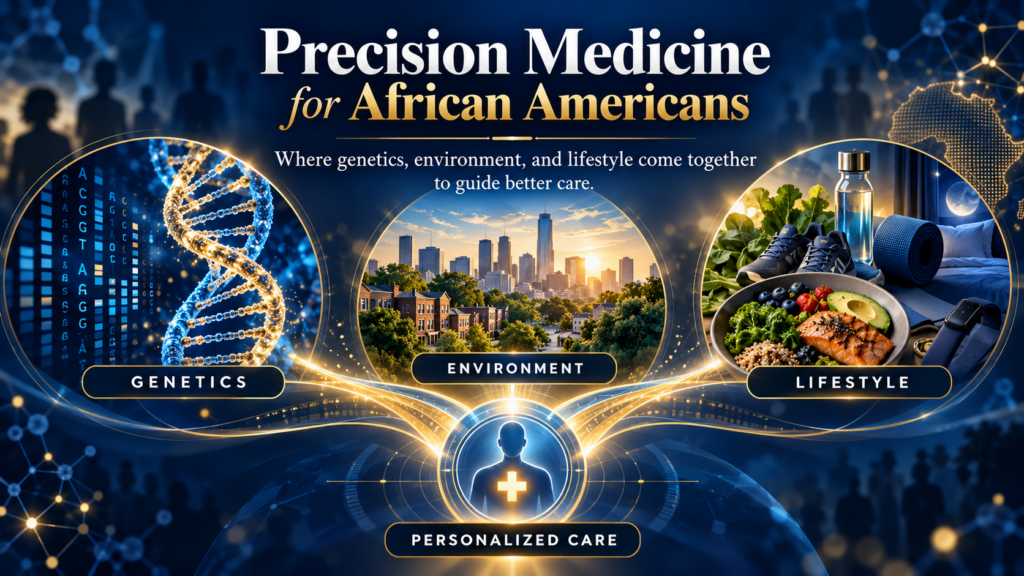
Precision medicine means fitting care to the person: their genes, biology, environment, and life experience. For African Americans, that means knowing where the evidence shows that the best approach is different. Examples include medication choice, how lab results are read, when screening should start, and how trust is built in the exam room.
This isn’t about treating people differently because of skin color. It’s about applying what the research shows so Black patients get the same good outcomes everyone deserves. “One size fits all” medicine has not delivered that.
The precision medicine approach, condition by condition
Each section below follows a chapter of the book and links to plain-language articles and videos on the topic.
Trust and communication
Good outcomes start with trust. Distrust of medicine has historical roots, and it affects whether patients fill prescriptions, come back for follow-up, and agree to screening. Establishing trust when patients distrust doctors · Why African Americans fear medication side effects
Heart disease and high blood pressure
High blood pressure tends to start earlier and hit harder in Black adults. Salt sensitivity is more common, and the evidence supports particular first-line medicines. Lipoprotein(a), an inherited heart risk factor, also tends to run higher. Salt sensitivity · Lipoprotein(a)
Kidney disease and the APOL1 gene
APOL1 gene variants, found almost entirely in people of recent African ancestry, raise the risk of kidney disease. Kidney function equations have also changed in recent years, which affects how results are read. Salt, slavery, and the APOL1 gene · Kidney disease in African Americans
Diabetes and obesity
Diabetes and obesity are more common, and complications happen at higher rates. The right approach looks at screening, how lab markers like A1c are interpreted (and could be inaccurate), medication choice, and culturally relevant nutrition. Diabetes differences in African Americans · The HbA1c test is inaccurate in African Americans
Cancer
Black Americans die of several common cancers at higher rates, including breast, prostate and colorectal cancer. Earlier, consistent screening and clearing up myths save lives. The “air hits the cancer” myth · Blood clots after a cancer diagnosis · Lung cancer in African Americans · Calcium and advanced cancer in Black men · Breast cancer in African American women · Colon cancer in African Americans
Lab results and blood disorders
Some “abnormal” lab results are normal variation in people of African ancestry, such as a lower white blood cell count. Others, like sickle cell disease and sickle cell trait, need specific attention. Low WBC in African Americans is likely not a problem
Lung, rheumatic, digestive and liver disease
Asthma, lupus, sarcoidosis, and several digestive and liver conditions look different in African American patients: how common they are, how they show up, and how they respond to treatment. In the gut, most African Americans lose some ability to digest lactose after childhood, yet many tolerate small servings of dairy, yogurt or aged cheese, so cutting dairy entirely can shortchange calcium and vitamin D. H. pylori infection and stomach cancer are more common, colorectal cancer tends to appear at younger ages (screening should start by 45), and fatty liver disease, while less frequent than in some groups, still tracks closely with diabetes. The gut microbiome, shaped by diet and environment, is an emerging part of the picture. Lactose intolerance in African Americans · Probiotics and African American health
Stress, mental health, sleep and pain
Chronic stress affects the body, depression often goes undiagnosed, and pain is often undertreated. Each calls for a deliberate, bias-aware approach. Sleep differences in African Americans · Sleep apnea in African Americans · Pain is not adequately treated in African Americans
Nutrition and supplements
Nutritional needs differ too. Low vitamin D is a common example. Low vitamin D in African Americans · Vitamin needs after 50 · Is the blood type diet “precision nutrition”?
“If race is a social construct, why does it matter?”
This is the question asked most often. Ancestry, genetics, environment and lived experience all shape health, and ignoring real differences in outcomes doesn’t make them go away. Read the full answer
The book

Precision Medicine for African Americans: A Concise, Evidence-Based Guide to Important Differences and Better Outcomes, 2nd edition (Springer Nature, 2025). Sixteen chapters for physicians, nurses, pharmacists and students, covering cardiovascular, diabetes and obesity, cancer, renal, rheumatic, pulmonary, hematologic, GI and hepatic care, mental health, pain, nutrition, emotional intelligence, and professional responsibility.
Softcover ISBN 978-3-031-95773-4 · eBook ISBN 978-3-031-95774-1
Get it from Springer · Get it on Amazon · All books by Gregory L. Hall, MD
About the author

Gregory L. Hall, MD is an internal medicine physician with more than 30 years in clinical practice and public health. He is President of the Cuyahoga County Board of Health, Founder of the National Institute for African American Health (NIAAH), Associate Clinical Professor at Case Western Reserve University School of Medicine, Pri-Med faculty, a 2025 Library of Congress HistoryMakers inductee, and host of Better Black Health TV.