


Is there something wrong with me?
Several of my patients have asked me why the white blood cell (WBC) count on their CBC (complete blood count) was flagged in red as abnormal.
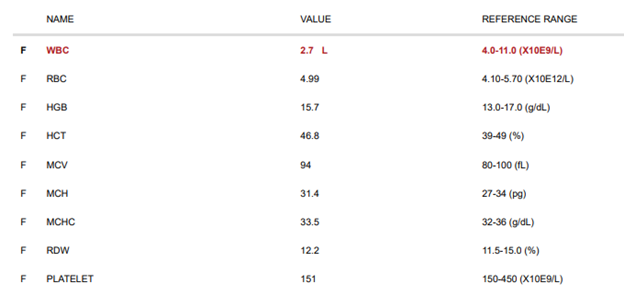
After digging deeper into the lab result, they saw this:

In many Black patients, this pattern reflects a normal, inherited variation, not a disease. It gets flagged as “abnormal” mainly because most lab reference ranges were built from studies of predominantly White populations. But not every low count is harmless, and below I explain how to tell the difference.
Benign ethnic neutropenia, now called Duffy-null associated neutrophil count
A neutrophil is the type of white blood cell that fights bacterial infections. For decades, doctors called low neutrophil counts in healthy people of African descent “benign ethnic neutropenia.” We now know the cause: a variant in the ACKR1 gene, also called the Duffy gene, identified in a landmark 2009 genetic study. People who carry two copies are “Duffy-null.” Their neutrophils are just as capable; more of them sit in tissues and fewer circulate in the blood, so the blood test reads lower. Hematologists increasingly use the more precise name Duffy-null associated neutrophil count, because it is defined by a gene, not by race.
This matters beyond a red flag on a lab report. Healthy Black patients with low counts have been sent for expensive and unnecessary testing, including bone marrow biopsies, and studies have shown that chemotherapy doses were more often reduced or delayed in Black patients because their counts looked “too low,” even when those counts were normal for them.
Am I affected?
About two out of three African Americans are Duffy-null, compared with fewer than 1 in 100 people of European or Asian ancestry (American Society of Hematology). The variant also occurs in some people with roots in the Middle East and the Arabian Peninsula. In a national survey, about 4.5% of Black Americans had neutrophil counts below the standard cutoff of 1,500, compared with under 1% of White Americans (Annals of Internal Medicine, 2007). Researchers later traced most of that difference to the Duffy variant (genetic research). Among Duffy-null adults in a large Vanderbilt study, about 17% had a count below 1,500 at some point.
Is it harmful?
Large studies have found that Duffy-null people with lower neutrophil counts do not have a higher risk of infection (American Society of Hematology). The trait usually runs in families, so a family history of “low white count” is a helpful clue. Once it is confirmed and documented in your chart, you usually need no extra monitoring or change in care.
The precision medicine connection
This is precision medicine in its clearest form: a single gene explains a lab difference that has caused real harm when doctors judged it by race or by a one-size-fits-all range.
1. Ask for a Duffy test
Duffy status can be checked with an inexpensive blood-typing test, the same kind used by blood banks, or with genetic testing. A result of Fy(a−b−) means you are Duffy-null. Knowing your status turns a guess based on race into a fact about you, and it belongs in your medical record.
2. Know when a low count still needs a closer look
Even in Duffy-null adults, counts below 1,000 are uncommon (about 5.5% in the Vanderbilt study), and counts below 500 are rare. See your doctor if your neutrophil count is below 1,000, if it keeps falling over time, if your red blood cells or platelets are also low, or if you have frequent fevers, mouth sores, or infections. Duffy-null status explains a mildly low count; it does not explain everything.
3. It can change your treatment
Many medicines and clinical trials use neutrophil cutoffs. Cancer chemotherapy, the schizophrenia medicine clozapine, and some rheumatology and HIV drugs are dosed or monitored using these counts, and many cancer trials have excluded people whose counts were normal for Duffy-null individuals. If you need one of these treatments, make sure your doctor knows your Duffy status so your care is not delayed or reduced unnecessarily.
These are the kinds of differences covered in Better Black Health, written for patients and families, and Precision Medicine for African Americans (Springer Nature), written for clinicians. If a low WBC has ever worried you or someone in your family, they are worth a read.
It’s also why I formulated GNetX Sequence multivitamins around what the research actually shows about Black health, rather than a one-size-fits-all standard.