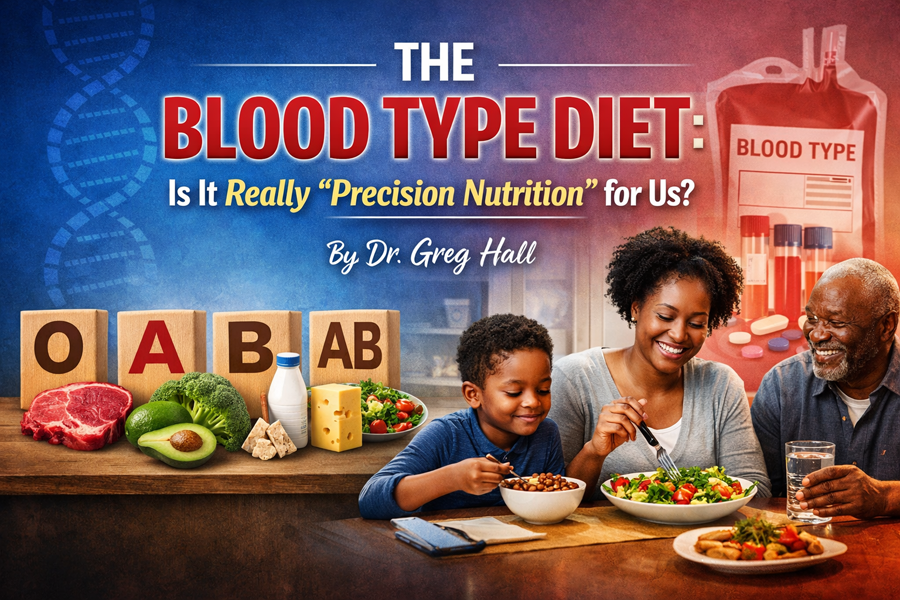

My patients often ask me what their blood type is. From my perspective, we only check this before surgery in case a transfusion is needed. Why do they ask? It’s usually a supplement they saw on social media or the Blood Type Diet.
You may have heard it before:
“If you’re Type O, you should eat more meat.”
“If you’re Type A, you should go mostly vegetarian.”
“Your blood type determines what foods work best for you.”
Now, as many of you know, I’m a strong advocate for precision medicine for African Americans. I wrote Precision Medicine for African Americans for clinicians and Better Black Health for patients and families. I believe in tailoring health strategies to our biology and our realities.
But precision only works when it’s grounded in real science.
And when you actually look at the evidence, the Blood Type Diet does not hold up.
What the Blood Type Diet Claims
The diet assigns eating patterns based on your ABO blood group:
- Type O (“the hunter”) → High-protein, meat-heavy, limit grains and beans
- Type A (“the farmer”) → Mostly vegetarian
- Type B → Mixed diet with more dairy
- Type AB → A combination approach
The theory says certain compounds in food — especially something called lectins — react differently depending on your blood type and can cause inflammation or disease if you eat the “wrong” foods.
It sounds scientific.
It sounds personalized.
But sounding scientific and being scientifically validated are two different things.
What the Research Actually Shows
A systematic review published in The American Journal of Clinical Nutrition looked at over 1,000 articles on blood type–based diets. The conclusion?
There were no studies that actually confirmed the main claims of the Blood Type Diet.[1]
In other words, there’s no strong evidence that your ABO blood type determines your ideal nutritional needs.
So why do some people say it works?
Because when people follow these plans, they often:
- Cut back on ultra-processed foods
- Reduce sugar
- Eat more intentionally
And that improves health — no matter what your blood type is.
The Dietary Guidelines for Americans — both the 2020–2025 edition and the new 2025–2030 edition — emphasize overall eating patterns built on whole foods, with less processed food and added sugar. Neither is based on blood type.[2] And the American Heart Association supports evidence-based dietary patterns like DASH and Mediterranean eating for heart protection.
Notice what’s missing? Blood type.
Let’s Talk About Type O — Because That’s Us
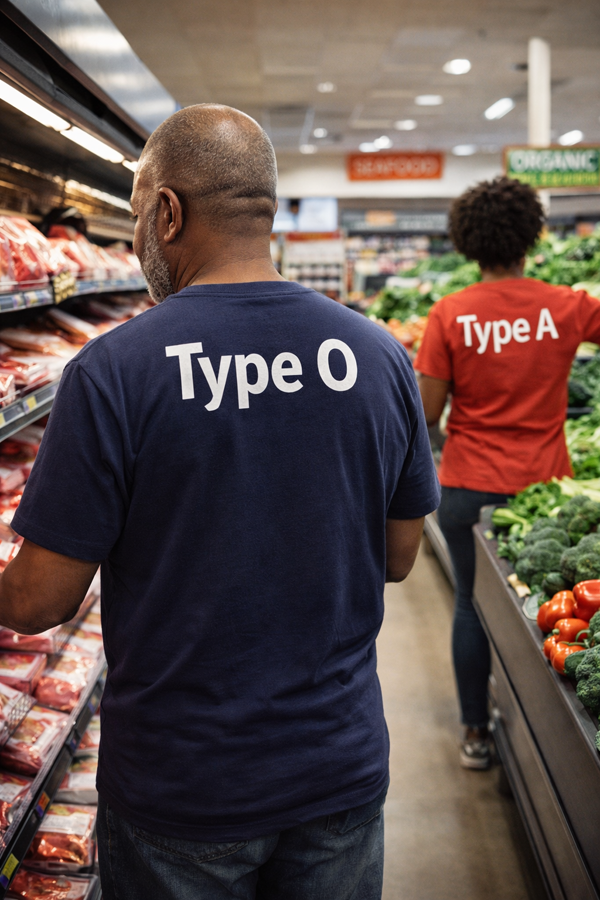
Here’s why this matters specifically for our community.
About 50% of African Americans are blood type O.[3]
And the Blood Type Diet tells Type O individuals to:
- Eat more red meat
- Limit grains
- Reduce beans and legumes
Now pause for a moment.
We already know that:
- Cardiovascular disease is the leading cause of death in our community.
- We have higher rates of hypertension, stroke, and heart failure.
At the same time, strong research shows that:
- High intake of processed and red meats increases cardiovascular risk.
- Whole grains and beans lower LDL cholesterol and improve insulin sensitivity.
There is no solid evidence that Type O individuals process grains or beans in a uniquely harmful manner. So encouraging a meat-heavy pattern in a population already facing high heart disease rates is not helpful.
The “Hunter” Story Sounds Good — But It’s Oversimplified
You’ll often hear that Type O is the “original” blood type and represents ancient hunters.
Here’s the reality:
ABO blood groups are ancient and complex. Human diets throughout evolution were diverse — including plant fibers, tubers, seeds, fruits, beans, and wild grains.
Blood type does not encode a specific ancestral diet plan, it determines transfusion compatibility.
Now Let’s Talk About the Supplements
This is where things get interesting.
There are companies selling:
- “Type O Digestive Support”
- “Type A Immune Boost”
- Blood-type-specific multivitamins
There is no scientific evidence that your ABO blood group determines your vitamin or mineral needs (and this is from a person who designed a multivitamin for African Americans).
Your blood type does not determine which supplements you need.
What Real Precision Nutrition Looks Like
Here is the irony: precision nutrition for Black Americans is real — it just is not based on blood type. It is based on biology we can actually measure and patterns we can actually document:
- Salt sensitivity. Most Black adults with high blood pressure are salt sensitive, so cutting sodium pays off more for us than for almost anyone. (Why our kidneys are so sensitive to salt.)
- Vitamin D. Darker skin makes less vitamin D from sunlight, so low vitamin D is common — and easy to check with a blood test.
- Lactose. African Americans are more likely to have trouble digesting lactose, the sugar in milk.[4] That affects how we get calcium — not our blood type.
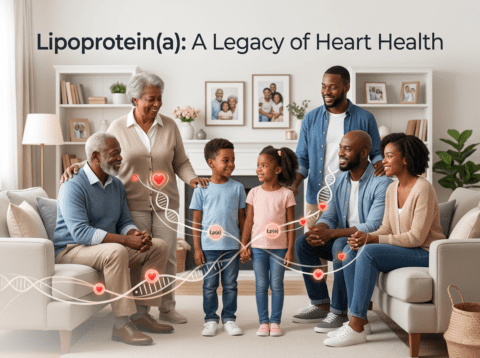
- Heart risk. Inherited risks like lipoprotein(a) make a heart-healthy, plant-forward eating pattern even more important.
And blood type does carry some real medical information — just not about food. People with type A, B, or AB have a somewhat higher risk of blood clots than people with type O.[5] That is useful for your doctor to know. It is not a reason to eat more steak.
References
- Cusack L, De Buck E, Compernolle V, Vandekerckhove P. Blood type diets lack supporting evidence: a systematic review. Am J Clin Nutr. 2013;98(1):99-104. pubmed.ncbi.nlm.nih.gov/23697707/
- U.S. Department of Agriculture and U.S. Department of Health and Human Services. Dietary Guidelines for Americans. dietaryguidelines.gov/
- Garratty G, Glynn SA, McEntire R; Retrovirus Epidemiology Donor Study. ABO and Rh(D) phenotype frequencies of different racial/ethnic groups in the United States. Transfusion. 2004;44(5):703-706. pubmed.ncbi.nlm.nih.gov/15104651/
- National Institute of Diabetes and Digestive and Kidney Diseases. Definition and facts for lactose intolerance. niddk.nih.gov/health-information/digestive-diseases/lactose-…
- Vasan SK, Rostgaard K, Majeed A, et al. ABO blood group and risk of thromboembolic and arterial disease. Circulation. 2016;133(15):1449-1457. ahajournals.org/doi/10.1161/circulationaha.115.017563