
For most of my career, I assumed that “minorities” in America lived shorter lives than white Americans. That is how health disparities are usually described: people of color on one side, white Americans on the other. When I looked closely at the latest national data, I realized I was wrong. I suspect many of you share the same assumption, and it matters, because it hides who is really falling behind.
What the numbers actually show
A March 2026 analysis by KFF of federal data found that in 2023, life expectancy at birth was:
- Asian Americans: 85.2 years
- Hispanic Americans: 81.3 years
- White Americans: 78.4 years
- Black Americans: 74.0 years
- American Indian and Alaska Native people: 70.1 years
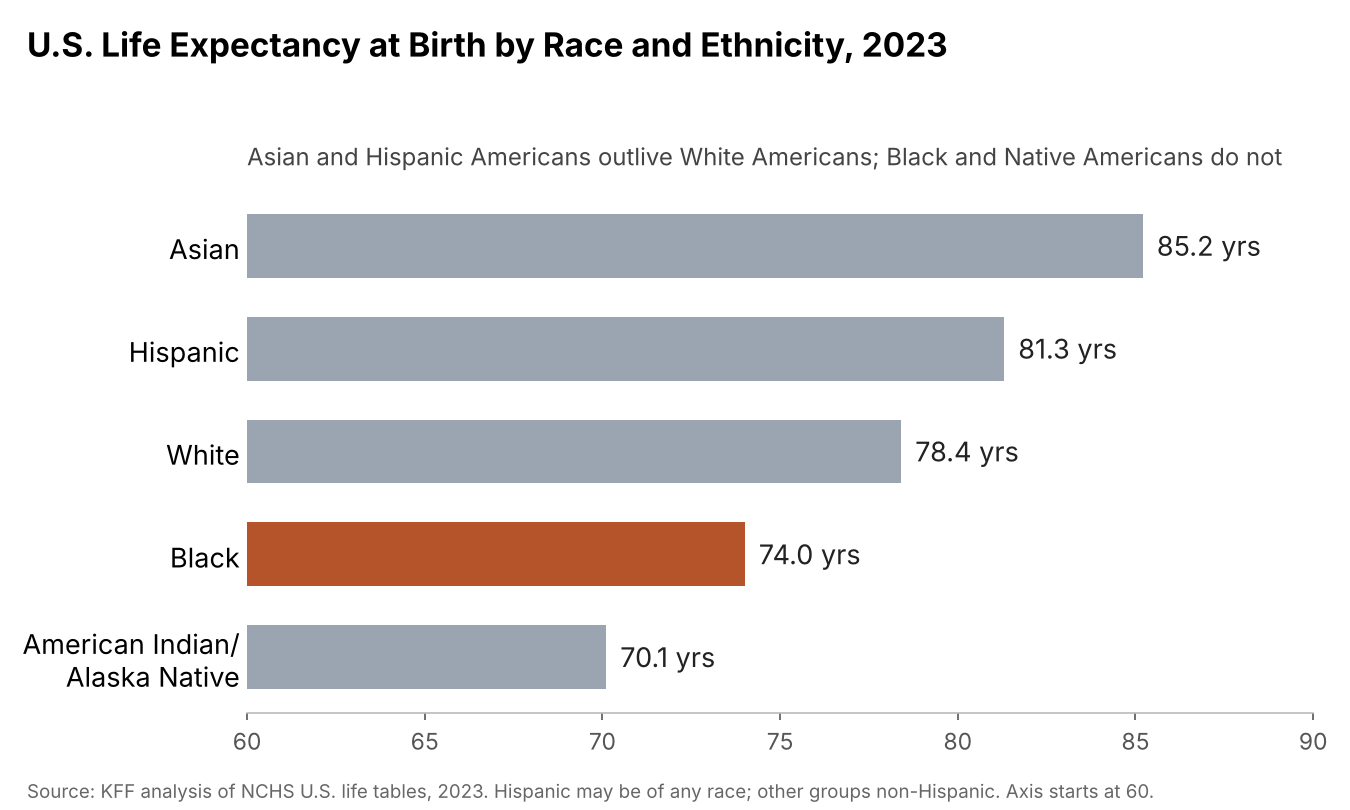
Asian Americans live almost 7 years longer than white Americans, and Hispanic Americans about 3 years longer. Black Americans live about 4.4 years less than white Americans and more than 11 years less than Asian Americans.
The newest numbers point the same way. Provisional CDC data for 2025 show the U.S. death rate fell to the lowest level ever recorded. Yet Black Americans still had the highest age-adjusted death rate of the major groups: 869 deaths per 100,000 people, compared with 724 for white, 501 for Hispanic and 367 for Asian Americans.
Why “minorities” hides the problem
When we lump every group of color together as “minorities,” the long lives of Asian and Hispanic Americans average away the short lives of Black and Native Americans. The result is a picture that looks less urgent than it is. The gap is not about being a minority. It is specific to Black and Native Americans, and it calls for solutions aimed at us.
Researchers are still studying why Hispanic Americans live longer than white Americans despite lower incomes and less access to care, sometimes called the Hispanic health paradox. Part of the answer may be better health among recent immigrants. The Asian American average also hides real differences between groups; KFF notes that Chinese Americans have the longest life expectancy and Vietnamese Americans the shortest. Those details are rarely discussed, and the Black-white gap often gets lost alongside them.
What is driving the gap for Black Americans
Heart disease and cancer are the leading causes of death for Black Americans, as they are for everyone, but they strike earlier and harder. According to the American Cancer Society, Black Americans are twice as likely as white Americans to die from myeloma, prostate, uterine and stomach cancers, and 40 to 50 percent more likely to die from colorectal, breast, cervical and liver cancers. Homicide remains the sixth leading cause of death among Black Americans. Lower rates of insurance, lower incomes, segregated neighborhoods and unequal access to care all play a part.
The precision medicine connection
Social and economic factors explain much of the gap, and they must be fixed. But part of the gap comes from inherited risks that we can find and act on today. That is where precision medicine can target better outcomes.
1. Cancer screening matched to risk
Because Black men are about twice as likely to die from prostate cancer, newer guidance recommends that Black men talk with their doctor about a baseline PSA test as early as age 40. I check all of my male patients’ over 40 PSA levels annually, no matter their age. All of my Black women get mammograms annually starting at 40 as well. A family history of breast, ovarian, prostate or pancreatic cancer is a reason to ask about genetic testing for inherited cancer risk.
2. An inherited cholesterol particle
Lipoprotein(a), or Lp(a), is a type of cholesterol particle set mostly by your genes. Levels are higher on average in people of African ancestry, and high levels raise the risk of heart attack and stroke. A standard cholesterol panel does not measure it. The National Lipid Association recommends that every adult have Lp(a) measured at least once.
3. A heart gene that shortens lives
About 3 to 4 percent of Black Americans carry a variant in the TTR gene (V142I, formerly called V122I) that causes protein deposits in the heart, known as cardiac amyloidosis. A 2024 study in JAMA found that carriers had more heart failure hospitalizations and lost an estimated 2 to 3 years of life. Across U.S. Black carriers ages 50 to 95, that adds up to nearly 1 million years of life lost. FDA-approved medicines now slow this disease, but only if it is diagnosed. Heart failure with thick heart walls, or carpal tunnel syndrome in both hands, should prompt a question about TTR testing.
4. Kidney failure and the APOL1 gene
Variants in the APOL1 gene explain much of the extra kidney failure in Black Americans, and a test can tell you whether you carry them. I explain who should be tested in my article on kidney disease in African Americans.
5. Tests that read differently
About 1 in 13 Black Americans has sickle cell trait, which can make the A1c test for diabetes read falsely low. That can delay a diabetes diagnosis. If you have the trait, your doctor may need to confirm results with a blood sugar test. Precision medicine means knowing when a standard test may not tell the whole story.

Genes are not destiny, and they are only part of the picture. But finding the risks we can treat is one of the fastest ways to start closing the gap.
To learn more, read Better Black Health, written for patients and families. Clinicians can find a deeper review in Precision Medicine for African Americans (Springer, 2nd ed., 2025).
What you can do
- Know your family history, especially early heart failure, kidney failure, cancer and sudden death.
- Ask for a lipoprotein(a) test at least once.
- Know whether you carry sickle cell trait, and make sure your doctor knows too.
- If you or a family member has heart failure or a thickened heart, ask about testing for the TTR gene.
- Keep your cancer screenings on schedule, and ask whether you should start earlier.
- Have a primary care doctor you see regularly. Read why primary care matters so much for Black patients.