

More and more Black men I know, including patients, colleagues and friends, have found a new place to gather: the cigar lounge. Leather chairs, good bourbon, a hand-rolled cigar, and conversation about business, family and life. Black-owned lounges have opened in cities across the country, from New Jersey to Birmingham, where one founder called the cigar lounge “the country club of the indoors.”
I understand the appeal. For many Black professionals, these lounges offer something we have not always been welcomed into: a place to network, mentor and relax. But I often hear the same thing from the men who enjoy them: “It’s not like cigarettes. I don’t inhale, and I only have one on the weekend.” Is that true?
Premium cigars are not a safe cigarette
In 2022, the National Academies of Sciences, Engineering, and Medicine reviewed the evidence on premium cigars, the hand-rolled, whole-leaf cigars sold in lounges and humidors. Their conclusion: the toxic and cancer-causing chemicals in premium cigar smoke are nearly identical to those in cigarette smoke, and they can cause heart disease, lung cancer, oral, head and neck cancers, and lung disease. How much harm a person suffers depends on how often they smoke, how long, and how deeply they inhale.
A national study of more than 350,000 Americans, published in JAMA Internal Medicine in 2018, found that people who smoked only cigars had a 20 percent higher risk of dying from any cause and a 61 percent higher risk of dying from tobacco-related cancers, including cancers of the mouth, larynx (voice box), esophagus, lung, pancreas and bladder, compared with people who never used tobacco.
“I don’t inhale”
Not inhaling lowers the risk to the lungs, but it does not protect the mouth and throat. Cigar smoke sits in the mouth, and nicotine is absorbed directly through the lining of the mouth, so cigars are still addictive. Cigar smoke also bathes the lips, tongue, throat and voice box in the same carcinogens. Men who once smoked cigarettes are more likely to inhale cigar smoke out of habit, which brings the lung risk right back. And a single large premium cigar can contain as much tobacco as an entire pack of cigarettes.
Cigars and bourbon: a risky pairing

Cigar culture often goes hand in hand with whiskey, cognac or wine. Using tobacco and alcohol together raises the risk of head and neck cancers far more than either one alone. This matters for us, because a large study in JAMA Otolaryngology found that Black patients with head and neck cancer had worse survival than patients from other racial and ethnic minority groups, with insurance, income and stage at diagnosis all playing a role.
What about the smoke in the room?
Even if you don’t smoke, an evening in a lounge means breathing secondhand smoke. The National Academies found there is not yet enough research on premium cigar smoke specifically, but noted a plausible concern for people with heart disease. The U.S. Surgeon General has concluded there is no safe level of secondhand smoke. In Ohio, retail tobacco stores that meet certain conditions are exempt from the state’s smoke-free workplace law, which is how many lounges allow smoking indoors. Lounge employees breathe that smoke every shift. A bill now in an Ohio House committee, House Bill 549, would create new rules for cigar bars and a sales tax exemption for cigars.
Fewer rules than cigarettes
Premium cigars have even less federal oversight than cigarettes. In April 2026, a federal judge issued a final ruling removing premium cigars from the FDA’s tobacco rules, ending a decade-long court fight. The National Academies also found that cigar lifestyle magazines and events often market premium cigars as a product whose benefits outweigh the risks, and sometimes imply they are a safe substitute for cigarettes. They are not.
The precision medicine connection
Precision medicine means looking at your own pattern of use, your history and your body, not just the label on the box. If you enjoy cigars, these are the points I would want you and your doctor to consider.
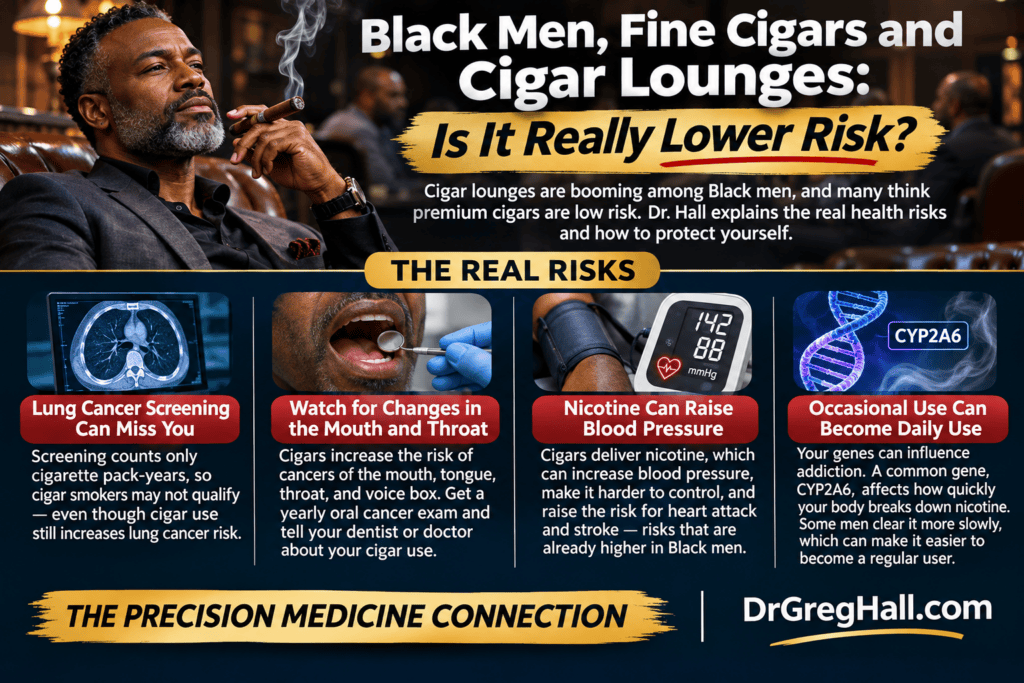
1. Lung cancer screening may miss you
Lung cancer screening rules are based on pack-years of cigarette smoking. Cigar-only smokers are not counted, even though cigars cause lung cancer, especially in men who inhale. If you smoked cigarettes in the past and switched to cigars, your cigarette history still counts. Tell your doctor about all of your tobacco use, and read more in my article on lung cancer screening in African Americans.
2. Know the warning signs in your mouth and throat
Because cigar smoke hits the mouth and voice box first, ask your dentist to do an oral cancer exam at every cleaning, and tell your doctor right away about a mouth sore that does not heal in two weeks, a lump in the neck, trouble swallowing, or hoarseness that lasts more than three weeks. Finding these cancers early makes a big difference in survival.
3. Your blood pressure and heart
Nicotine absorbed through the mouth still raises blood pressure and heart rate. High blood pressure is more common and starts earlier in Black men, and nicotine adds strain on top of it. If you have high blood pressure, heart disease or diabetes, cigars and the smoke in a closed lounge are a bigger risk for you than for the average person.
4. Occasional can become daily
Most premium cigar smokers are occasional users, which is why the National Academies called their overall population risk modest. But risk rises with frequency, and nicotine is addictive whether you inhale or not. How quickly your body clears nicotine, controlled by the CYP2A6 gene, affects cravings and how hard it is to stop. If one cigar on Saturday has turned into one most evenings, that is the time to talk with your doctor. I explain more about nicotine metabolism and quitting in my article on menthol cigarettes and Black & Milds.
To learn more, read Better Black Health, written for patients and families. Clinicians can find a deeper review in Precision Medicine for African Americans (Springer, 2nd ed., 2025).
Keep the brotherhood, lower the risk
The community in these lounges is real and valuable. The cigar does not have to be the price of admission. If you choose to smoke, these steps lower your risk:
- Smoke less often, and never let it become a daily habit.
- Do not inhale, especially if you are a former cigarette smoker.
- Limit alcohol when you smoke, and alternate with water.
- Choose well-ventilated or outdoor spaces, and avoid long hours in smoky rooms.
- Get a yearly oral cancer check from your dentist, and keep your blood pressure under control.
- If you want to cut back or quit, call 1-800-QUIT-NOW or talk with your doctor.