
I’ve written before about why Black Americans carry a higher baseline risk of blood clots, and why that’s the reason GNetX Sequence Multivitamins for African Americans has never contained added vitamin K — you can read the fuller case in Best Multivitamins for African Americans and in Vitamin K2, Vitamin D3, and Black Health. What I haven’t laid out yet is where that baseline risk concentrates hardest — and it isn’t random. It spikes during a hospital stay, and it spikes again during cancer treatment. Both are moments where patients can advocate for themselves, if they know what to ask for. It’s also a textbook case for precision medicine: the genetic clotting tests most doctors reach for were built around variants that are common in white patients and rare in Black patients, so a “normal” result can miss where your real risk lies. Here’s what the research shows.
Hospital-Acquired Blood Clots: More Common, and More Preventable, Than Most Patients Know
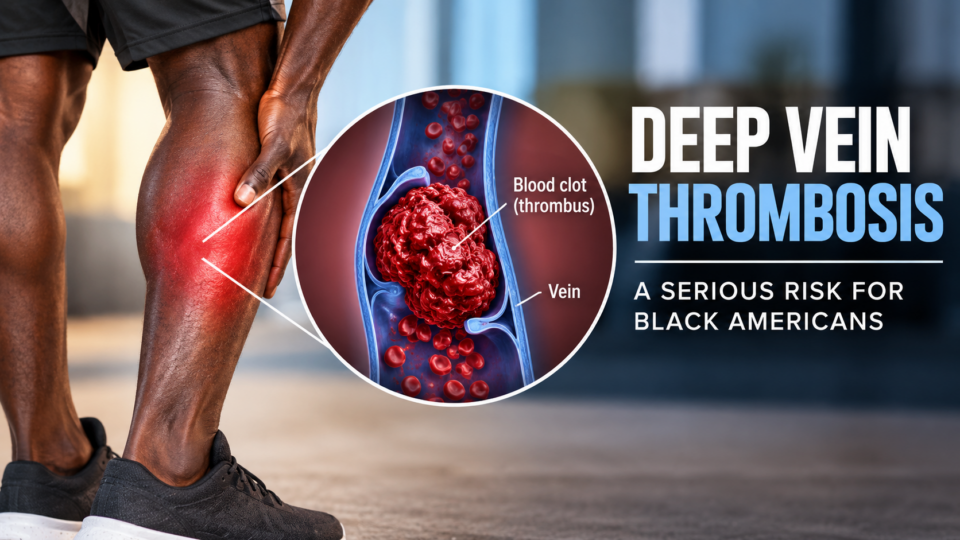
Venous thromboembolism (VTE) — the umbrella term for DVT and pulmonary embolism together — affects up to 900,000 Americans a year, and the CDC calls it “a leading cause of preventable hospital death in the United States,”[1] responsible for an estimated 60,000 to 100,000 deaths annually. More than a third of all VTE cases diagnosed each year trace back to a recent hospitalization. Three things drive that risk up the moment you’re admitted: vein injury from surgery, a fracture, or trauma; reduced blood flow from bed rest and immobility; and complications from central venous catheters. Among surgical patients specifically, about 40% of clots form during the hospital stay itself, and the other 60% show up within 90 days after discharge — which is exactly why the risk doesn’t end at checkout.
Here’s the part that should change how you think about a hospital stay: the CDC estimates that up to 70% of hospital-associated VTE is preventable with anticoagulants, compression devices, or both — yet fewer than half of hospitalized patients who need that prophylaxis actually receive it nationally.
The Prophylaxis Paradox for Black Patients
You’d expect that closing the prophylaxis gap would close the outcome gap. The data says otherwise. A 2022 study in The American Surgeon, covering more than 285,000 severe trauma patients nationwide, found Black patients received preventive blood thinners at the highest rate of any racial group (73.8%, versus 63.7% for white patients) and received it fastest, at a median of 1.6 days. Despite faster, more frequent prophylaxis than every other group, Black patients still had the highest rates of both DVT (2.8%) and PE (1.4%) in the study.[2]
That gap likely reflects biology as much as anything happening on the hospital floor. Up to 8% of Black Americans carry sickle cell trait, which alone raises PE risk roughly fourfold,[3] and researchers have identified genetic variants on chromosome 20 — more common in Black populations — independently linked to elevated DVT risk, although not every one of those findings has held up in later studies.[4] Chronic conditions more prevalent in Black Americans, including metabolic syndrome, hypertension, diabetes, and chronic kidney disease, add further risk on top of that; in one 151,000-patient study, 68% of DVT patients had at least one metabolic syndrome component. Separately, research measuring thrombin generation — essentially how aggressively blood forms clots — has found it significantly higher in African-Caribbean patients than in white patients, even among healthy people with no clotting history at all[5]. Black patients also carry the highest documented risk of DVT after surgery generally, and those presenting with a PE tend to arrive at the hospital already in more serious condition than other groups — a pattern that may point to delayed access to care earlier in the disease course. Prevention protocols matter. They’re not the whole answer.
Cancer and Clots: The Risk Almost Nobody Mentions at Diagnosis
Cancer raises clot risk for every patient, not just some. Tumors can activate clotting directly, chemotherapy and surgery add their own risk, and the immobility that comes with treatment compounds it further. This combination has a name — cancer-associated thrombosis, or CAT — and it is not a minor side effect: in one cohort of 4,466 cancer patients on chemotherapy followed for a median of 75 days, thrombosis was the second leading cause of death (9%), behind only cancer progression itself (71%).[6]
That risk isn’t distributed evenly either. A large analysis in Blood Advances covering more than 942,000 cancer patients found an overall CAT incidence of 6.6% — but after adjusting for other risk factors, Black patients had a higher risk of CAT than white patients across nearly every cancer type studied, a gap driven primarily by pulmonary embolism.[7] Black patients had the highest combined 12-month rate of PE and DVT for every cancer type examined except bladder cancer and myeloma; Asian and Pacific Islander patients had the lowest. The study’s authors were careful to note that a disparity this consistent, across this many cancer types, is unlikely to come from genetics alone — they point instead to unequal access to care, differences in quality of care, and broader social determinants of health as likely contributors.
If you or someone you love is sitting in an oncologist’s office for the first time, clot risk is very likely not the first thing on anyone’s mind, but it definitely needs to be on the list.
What Precision Medicine Adds: Your Personal Clot Risk
Here is where a one-size-fits-all approach falls short. When doctors order a “clotting workup,” they usually test for factor V Leiden and the prothrombin gene mutation. Those are the classic inherited clotting risks — but factor V Leiden is found in about 5% of white Americans and only about 1% of African Americans.[8] A Black patient can get a completely normal result and still carry real risk from sickle cell trait, kidney disease, a particular cancer, or simply biology we don’t yet test for. Precision medicine means looking at the risks that actually apply to you — not the ones the standard panel was designed to find.
What to Ask Your Care Team
- In the hospital: “Have I had a blood clot risk assessment, and am I getting prevention — a blood thinner, compression devices, or both?” Ask again at discharge: “Should I keep taking it at home, and for how long?”
- At a cancer diagnosis: “What is my risk of a blood clot during treatment?” Oncologists use a simple tool called the Khorana score. National cancer guidelines say high-risk patients starting chemotherapy may be offered a preventive blood thinner.[9]
- Know your sickle cell trait status. Many adults don’t know whether they carry it. A simple blood test can tell you — and every doctor who treats you should know the answer.
- Share your full history. Tell your team about any family history of blood clots, kidney disease, recent surgery, or long trips. These details change your personal risk.
Know the Warning Signs
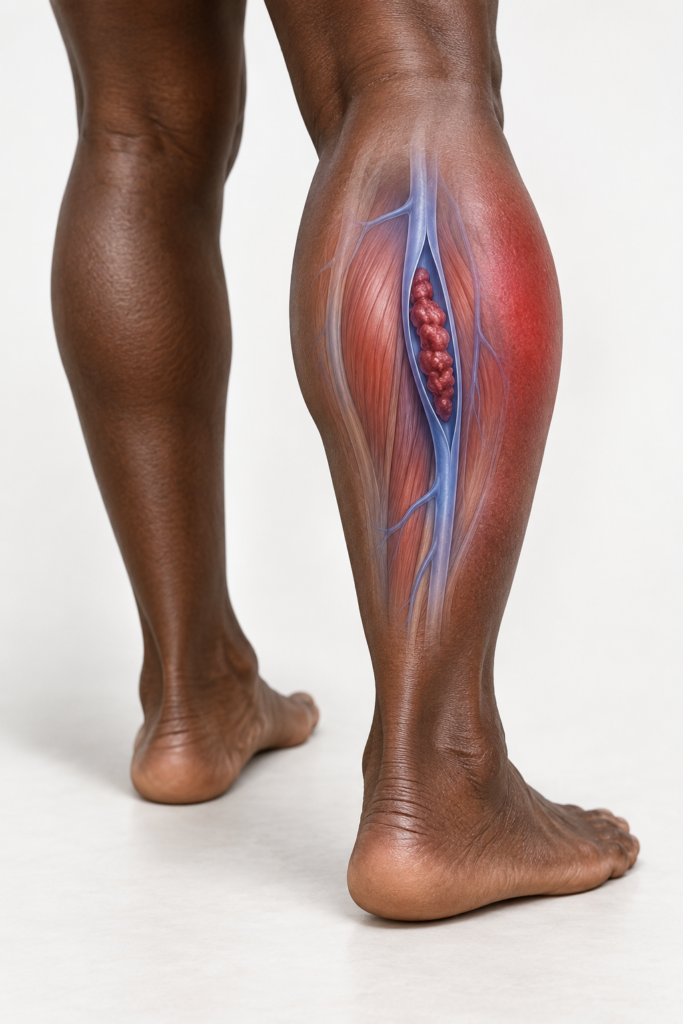
A DVT usually shows up in one leg: swelling, pain or tenderness (often worse standing or walking), warmth, and redness. A PE is a medical emergency — sudden shortness of breath, chest pain that worsens with a deep breath, a racing heartbeat, lightheadedness, or coughing up blood all warrant a call to 911, not a wait-and-see approach. The CDC notes that sudden death is the first symptom in roughly 1 in 4 pulmonary embolism cases, which is exactly why leg symptoms should never get written off as a pulled muscle.
Watch: Blood Thinners and Anticoagulation: What Patients Should Know
References
- Centers for Disease Control and Prevention. Data and statistics on venous thromboembolism. cdc.gov/blood-clots/data-research/facts-stats/index.html
- Racial differences in venous thromboembolism prophylaxis and outcomes among more than 285,000 severely injured trauma patients. Am Surg. 2022. doi.org/10.1177/00031348221129519
- Austin H, Key NS, Benson JM, et al. Sickle cell trait and the risk of venous thromboembolism among blacks. Blood. 2007;110(3):908-912. doi.org/10.1182/blood-2006-11-057604
- Hernandez W, Gamazon ER, Smithberger E, et al. Novel genetic predictors of venous thromboembolism risk in African Americans. Blood. 2016;127(15):1923-1929. pubmed.ncbi.nlm.nih.gov/26888256/
- Roberts LN, et al. African-Caribbean ethnicity is associated with a hypercoagulable state as measured by thrombin generation. Blood Coagul Fibrinolysis. 2013;24(1). journals.lww.com/bloodcoagulation/fulltext/2013/01000/africa…
- Khorana AA, Francis CW, Culakova E, et al. Thromboembolism is a leading cause of death in cancer patients receiving outpatient chemotherapy. J Thromb Haemost. 2007;5(3):632-634. pubmed.ncbi.nlm.nih.gov/17319909/
- Datta T, Brunson A, Mahajan A, Keegan T, Wun T. Racial disparities in cancer-associated thrombosis. Blood Adv. 2022;6(10):3167-3177. ashpublications.org/bloodadvances/article/6/10/3167/484067/R…
- Ridker PM, Miletich JP, Hennekens CH, Buring JE. Ethnic distribution of factor V Leiden in 4047 men and women: implications for venous thromboembolism screening. JAMA. 1997;277(16):1305-1307. pubmed.ncbi.nlm.nih.gov/9109469/
- Key NS, Khorana AA, Kuderer NM, et al. Venous thromboembolism prophylaxis and treatment in patients with cancer: ASCO clinical practice guideline update. J Clin Oncol. 2020;38(5):496-520 (updated 2023). doi.org/10.1200/JCO.19.01461