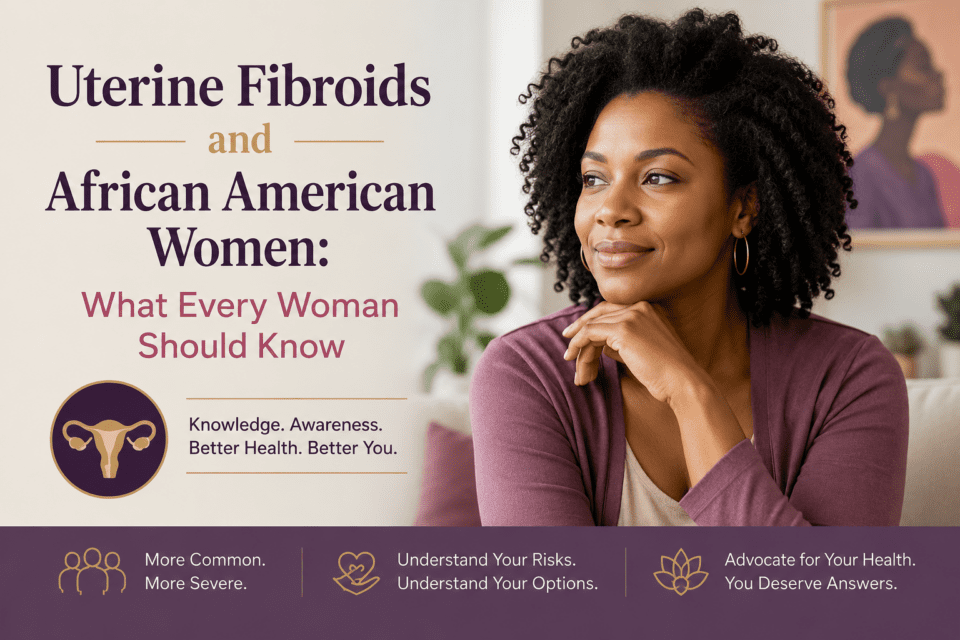
If you are a Black woman in your twenties, thirties, or forties, there is a very real chance that fibroids will become part of your life story — if they aren’t already. By age 50, an estimated 80% of African American women will have developed uterine fibroids, compared with roughly 70% of white women, and Black women are more likely to develop them earlier, experience more severe symptoms, and undergo more invasive treatment. Understanding why this happens — and what you can do about it — is one of the most important conversations in women’s health today.
The Numbers Tell a Story
Uterine fibroids — noncancerous growths in or on the muscular wall of the uterus — are the most common pelvic tumor in women. But the burden is not shared equally. Research from the National Institutes of Health, Michigan Medicine, and the American Journal of Obstetrics & Gynecology paints a consistent picture:
- Earlier onset: Among women ages 18–30, roughly 26% of Black women already have ultrasound-detectable fibroids, compared with about 7% of white women.
- Higher lifetime risk: By age 35, around 60% of Black women have fibroids; by age 50, that figure climbs to 80% or higher.
- More severe disease: Black women tend to have larger fibroids, more of them, and more debilitating symptoms — including the anemia, fatigue, and quality-of-life impacts that come with heavy bleeding.
- More aggressive treatment: Compared with white women, Black women are roughly 2 to 3 times more likely to undergo hysterectomy and significantly more likely to need repeat surgical procedures.
These differences are not small, and they are not new. What is changing is our understanding of why they exist.
Why the Disparity Exists
There is no single reason Black women are disproportionately affected by fibroids. Researchers now describe it as a layered problem with biological, environmental, and social roots.
Genetics and family history
Fibroids tend to run in families, and recent genetic studies show that the frequency of certain fibroproliferative risk variants is higher in people of African ancestry. A mother’s history of fibroids is one of the strongest predictors of a daughter’s risk.
Hormonal and reproductive factors
Earlier first menstrual periods, longer reproductive years, and differences in estrogen and progesterone exposure may all play a role. Vitamin D deficiency — more common in Black women because of how skin pigmentation interacts with sunlight — has also been linked to fibroid growth.
Chronic stress and the body’s wear and tear
A growing body of research suggests that the chronic stress of racism, discrimination, and socioeconomic strain leaves measurable biological marks. Persistent activation of the body’s stress response disrupts hormone regulation in ways that may help fibroids form and grow.
Healthcare access and quality
Delayed diagnosis is itself a risk factor for severe disease. When symptoms are dismissed or care is unaffordable, fibroids have more time to grow, multiply, and damage quality of life. Lower insurance coverage, fewer specialists in many Black communities, and racial bias in clinical encounters all contribute.
Even when researchers account for every known biological and lifestyle factor, the racial gap does not fully close. That tells us the story is still being written.
Symptoms: What to Watch For
Many women have fibroids and never know it. But when symptoms appear, they tend to fall into a few recognizable patterns.
- Heavy or prolonged periods. Soaking through a pad or tampon every one to two hours, passing clots the size of a quarter or larger, or bleeding for more than seven days.
- Pelvic pressure or pain. A persistent dull ache, fullness, or bloating in the lower abdomen — sometimes mistaken for weight gain.
- Bladder and bowel symptoms. Frequent urination, waking at night to urinate, difficulty emptying the bladder, or constipation as fibroids press on nearby organs.
- Pain with intercourse. Discomfort in specific positions, or pain that fluctuates with the menstrual cycle.
- Fatigue and shortness of breath. These are often signs of iron-deficiency anemia from chronic blood loss — a frequently overlooked clue.
- Fertility or pregnancy concerns. Difficulty conceiving, recurrent miscarriage, or pregnancy complications can sometimes be traced to fibroids.
Schedule an appointment if any of these symptoms are interfering with daily life. Seek emergency care for sudden, severe pelvic pain or heavy bleeding accompanied by dizziness, lightheadedness, or weakness.
You Have More Treatment Options Than You May Realize
For decades, the default conversation about fibroids ended at hysterectomy. That is no longer the standard of care. Today, treatment exists on a spectrum, and the right choice depends on your symptoms, your size and location of fibroids, your age, and whether you want to preserve fertility.
Watchful waiting
If fibroids are small and asymptomatic, monitoring with regular imaging may be all that is needed.
Medication
Hormonal birth control, IUDs, and tranexamic acid can reduce bleeding. Newer GnRH antagonist therapies such as Oriahnn (elagolix) and Myfembree (relugolix) combine hormone-blocking medication with add-back therapy to control heavy bleeding for up to 24 months. These medications manage symptoms but do not eliminate fibroids, and they carry warnings about bone loss and clotting that should be discussed carefully.
Uterine fibroid embolization (UFE)
A minimally invasive procedure performed by an interventional radiologist. Tiny particles are injected through a catheter to cut off blood flow to the fibroids, causing them to shrink. Most women go home the same day and recover in about a week. UFE preserves the uterus and has been shown to be safer than surgery for many patients.
Myomectomy
Surgical removal of individual fibroids while leaving the uterus intact. It is the preferred surgical option for women who want to preserve fertility. It can be performed via open surgery, laparoscopically, or hysteroscopically depending on fibroid size and location.
Radiofrequency ablation and focused ultrasound
Newer image-guided techniques (such as the Acessa procedure and MR-guided focused ultrasound) destroy fibroid tissue without removing it, with shorter recovery times than traditional surgery.
Hysterectomy
Removing the uterus is the only definitive cure, and it remains the right choice for some women — but it should be one option among many, not the only one offered. If hysterectomy is the first treatment proposed before less invasive options are considered, that is a signal to ask more questions.
Advocating for Yourself in the Exam Room

One of the most painful patterns in fibroid care is the experience so many Black women describe of having their pain minimized, their symptoms attributed to weight or stress, or their concerns brushed aside until the disease has progressed. You do not have to accept that experience as normal.
A few practical strategies
- Track your symptoms. Keep a written or app-based log of bleeding days, pad and tampon use, pain levels, and how symptoms interfere with work or sleep. Concrete data is harder to dismiss.
- Name what you want. Tell your provider plainly: “I want to understand all of my treatment options before deciding,” or “I want to preserve my fertility.”
- Ask for the full menu. If hysterectomy is recommended, ask: Am I a candidate for UFE? For myomectomy? For ablation? If the answer is no, ask why.
- Get a second opinion. Especially before any irreversible procedure. A consultation with an interventional radiologist or a fibroid-focused gynecologist can broaden your options significantly.
- Bring backup. A partner, friend, or family member in the room can help you remember questions and confirm what was said.
- Trust your body. If something feels wrong and you are being told it is normal, keep asking. You know your baseline better than anyone.
A Final Word
The disparity in how fibroids affect Black women is not your fault, and it is not inevitable. It is the result of biology, environment, history, and a healthcare system that has too often failed to listen. The good news is that awareness is growing, treatments are expanding, and you have more tools than ever to take charge of your care.
If you are experiencing symptoms — or simply want to know what is going on inside your own body — do not wait. Talk to a provider who takes you seriously, ask the questions that matter to you, and remember that getting the care you deserve is not a favor. It is your right.