
The Black mental health paradox
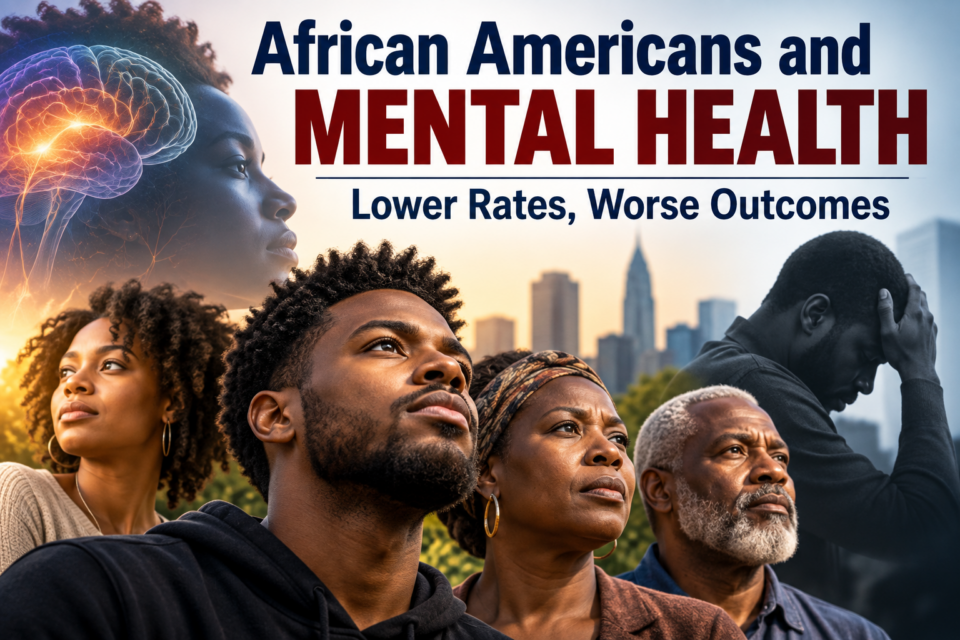
By and large, African Americans report fewer depression and anxiety disorders than White Americans in national surveys. In the National Survey of American Life, about 10% of African Americans had experienced major depression in their lifetime, compared with about 18% of White Americans (NIMH). Across racial groups, women are diagnosed with depression and anxiety more often than men, while men have higher rates of substance use disorders and suicide, which suggests depression in men is often missed.
But lower rates are only half the story. When African Americans do have depression, it is more often chronic (about 56% versus 39% in White Americans), more disabling, and less often treated. Fewer than half of African Americans with depression in that survey received any treatment. Researchers call this the “Black–White mental health paradox”: lower rates of diagnosis, but worse outcomes.
Why would rates be lower?

Scholars have tried to understand why African Americans, who carry a heavier burden of heart disease, kidney disease, and premature death, would show a lower psychiatric burden. Keep in mind that these theories are hypotheses that have not been confirmed or refuted. Sometimes in medicine, the best answer is “it is what it is.” Just as African Americans carry a higher burden of kidney and cardiovascular disease, surveys show a lower burden of some psychiatric disorders.
Jackson and colleagues at the University of Michigan proposed that chronic stress leads to unhealthy coping behaviors that may ease psychological distress in the short term but damage physical health over time:
Thus, we hypothesize that when individuals are chronically confronted with stressful conditions in daily life (e.g., poverty, crime, poor housing), they will engage in unhealthy behaviors (e.g., smoking, alcohol use and abuse, drug use, and overeating, especially of comfort foods) that help to alleviate the resulting symptoms of stress. However, these same behaviors silently contribute to physical health morbidities and early mortality.
Jackson, Knight, and Rafferty, American Journal of Public Health, 2010
Their theory suggests that these behaviors act on the body’s stress system, easing symptoms of stress while doing long-term harm to physical health. They proposed that the pattern differs by sex: overeating as a coping strategy that starts early in life in women, and rising rates of smoking, drinking, and drug use in men by middle age.
Other studies support the link between mental and physical health. In a national study of Black and White men, African American men 45 and older with mood or anxiety disorders were more likely to also have chronic physical conditions such as heart disease or diabetes.
Jackson’s theory would be stronger if substance use disorders were clearly more common in African Americans, but in many studies they are not. In a 12-year study of 1,829 youths followed after juvenile detention in Chicago, Leah Welty and colleagues at Northwestern University found that drug use disorders such as cocaine and hallucinogen use were least common among African Americans:
We found striking racial/ethnic differences. Contrary to popular stereotypes, … non-Hispanic Whites had more than 30 times the odds of having cocaine-use disorder than African Americans.
Welty et al., American Journal of Public Health, 2016
Lower rates do not mean lower risk
Surveys measure what gets reported and diagnosed. Depression in Black adults can look different, showing up as irritability, fatigue, sleep problems, or physical pain rather than sadness, and stigma and mistrust can keep people from talking about it. And some numbers are moving in the wrong direction: from 2018 to 2021, suicide rates among Black Americans rose about 19%, and among Black youth and young adults ages 10 to 24 they rose about 37%, faster than any other group (CDC).
The precision medicine connection
Mental health care is one of the areas where a one-size-fits-all approach most often fails Black patients.
1. Getting the right diagnosis
In a Rutgers study of 1,657 patients, African Americans with severe depression were more likely to be misdiagnosed with schizophrenia because clinicians did not give enough weight to their mood symptoms (ScienceDaily). A wrong diagnosis can mean the wrong medicines, with side effects like weight gain and diabetes. If you or a loved one receives a psychotic disorder diagnosis, ask whether depression or bipolar disorder has been fully considered.
2. Your genes affect how you process psychiatric medicines
The liver enzymes CYP2D6 and CYP2C19 break down many antidepressants and antipsychotics. Reduced-function versions of CYP2D6, such as CYP2D6*17 and *29, are much more common in people of African ancestry, which can lead to higher drug levels and more side effects at standard doses. International pharmacogenetic guidelines now give dosing advice for many antidepressants based on these genes (CPIC, 2023). If you have had bad side effects or no benefit from several medicines, ask whether pharmacogenetic testing could help.
3. A “low white count” should not block treatment
Clozapine, the most effective medicine for treatment-resistant schizophrenia, requires regular white blood cell monitoring. About two out of three African Americans carry the Duffy-null trait, which naturally lowers neutrophil counts, and many Black patients have been denied or taken off clozapine because of counts that were normal for them. Learn more in my article on low WBC and the Duffy-null gene.
These are the kinds of differences covered in Better Black Health, written for patients and families, and Precision Medicine for African Americans (Springer Nature), written for clinicians.
Getting help
If you are struggling, talk with your doctor, a counselor, or someone you trust. Depression is treatable. If you or someone you love is in crisis or thinking about suicide, call or text 988, the Suicide & Crisis Lifeline, available 24 hours a day.