
For decades, patients have been told that sickle cell trait is harmless. “You’re just a carrier,” the doctor says. “It only matters if you have children.”
That advice is out of date.
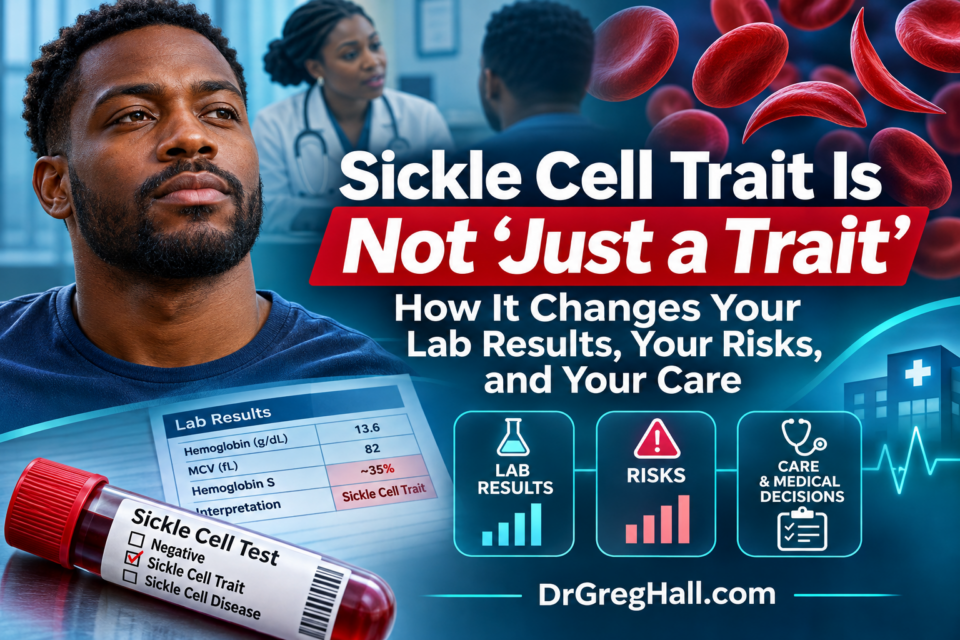
About 1 in 13 African Americans has sickle cell trait, and most of us do not know our status. Many adults were born before universal newborn screening, and many who were screened were never told the result. Yet the trait quietly affects how some of your lab tests read, which conditions you are more likely to develop, and which treatments a doctor should choose or avoid.
This is precision medicine at its most practical. Sickle cell trait is not a guess based on how someone looks. It is a specific, testable genetic variant with specific, measurable consequences. Knowing it changes care.
What sickle cell trait is
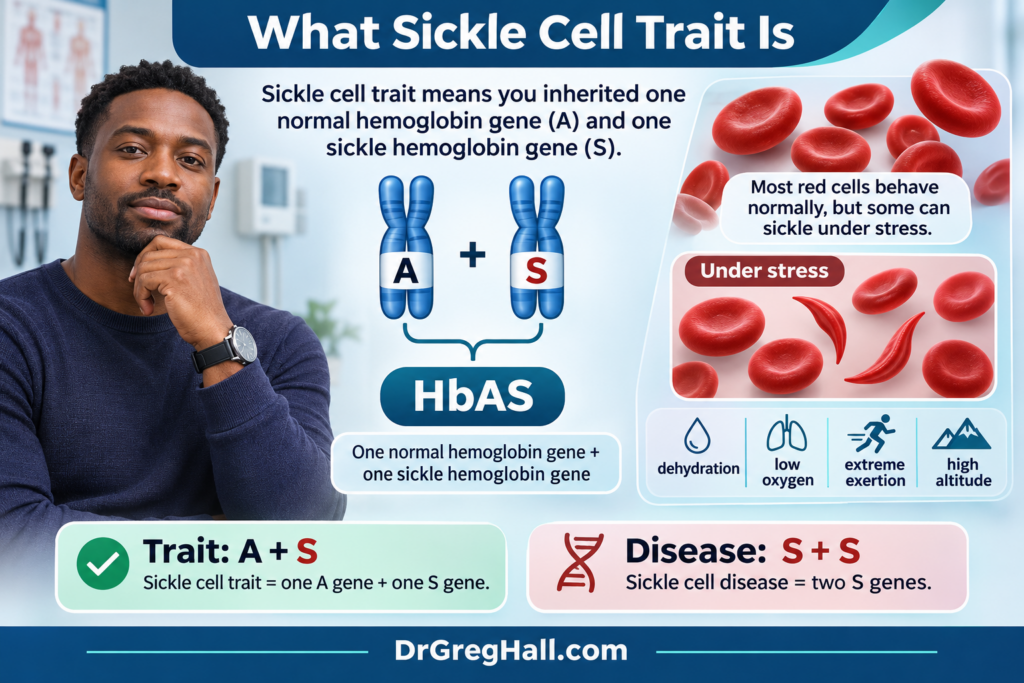
Hemoglobin is the protein in red blood cells that carries oxygen. Sickle cell trait means you inherited one normal hemoglobin gene (A) and one sickle hemoglobin gene (S). People with two sickle genes have sickle cell disease. People with one have the trait, usually written as HbAS.
The sickle gene became common in West and Central Africa for a reason: carrying one copy protects against severe malaria. That survival advantage is written into the ancestry of most African Americans. The trait is also found in people with roots in the Caribbean, Latin America, the Mediterranean, the Middle East, and India.
Under normal conditions, red cells in someone with the trait behave normally. But under stress—dehydration, extreme exertion, low oxygen, high altitude, acidic conditions—sickle hemoglobin can stiffen and distort cells. Some organs, especially the inner part of the kidney, live under those conditions every day. That is where many of the effects begin.
Your A1c may be reading low
The hemoglobin A1c test is the most common way doctors diagnose diabetes and track blood sugar control. It measures how much sugar has attached to your hemoglobin over roughly three months.
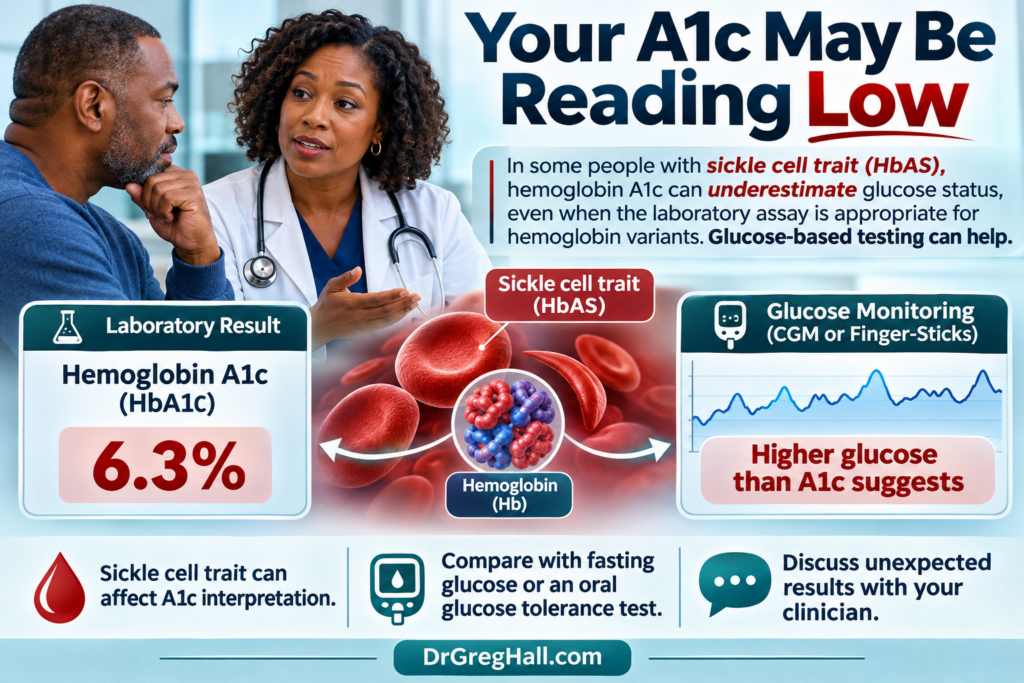
A landmark 2017 study in JAMA followed more than 4,600 African American adults from the CARDIA and Jackson Heart studies. People with sickle cell trait had A1c values about 0.3 percentage points lower than people without the trait, even when their fasting and two-hour glucose levels were the same. Using standard A1c cutoffs, the researchers identified about 40% fewer cases of prediabetes and 48% fewer cases of diabetes among people with the trait.
Think about what that means. A reading of 6.3% might really reflect blood sugar closer to 6.6%. A patient told “you’re borderline, watch your diet” may actually have diabetes. A patient with diabetes told “you’re at goal” may not be.
This is not just a lab machine problem. The study used an A1c method approved for people with hemoglobin variants, and the gap was still there. The likely explanation is biological, including differences in how long red cells survive. I have written more about why the A1c test can be inaccurate in African Americans.
What I recommend: If you have sickle cell trait, don’t let A1c be the only number. Ask for a fasting glucose, and when the answer matters, a two-hour glucose tolerance test. Fructosamine and continuous glucose monitoring are also useful. If your A1c and your glucose readings don’t agree, believe the glucose.
Your kidneys are working under stress
The kidney’s inner core (the medulla) is low in oxygen, salty, and acidic by design. Those are exactly the conditions that make sickle hemoglobin misbehave.
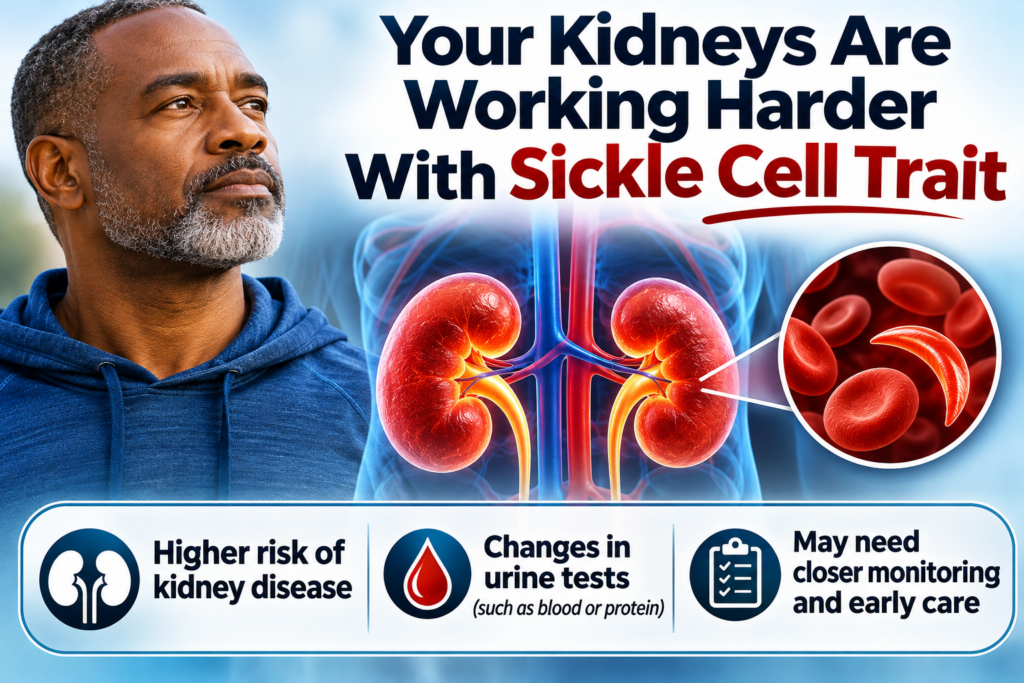
In 2014, researchers combined five large U.S. studies of nearly 16,000 African Americans and published the results in JAMA. People with sickle cell trait had:
- Higher rates of chronic kidney disease (incident CKD in 20.7% of carriers vs. 13.7% of non-carriers)
- Faster decline in kidney function
- Nearly double the odds of albuminuria, protein leaking into the urine, which is one of the earliest signs of kidney damage
A later study of Black patients found that those with the trait lost kidney function slightly faster each year than those without it.
To be fair to the evidence, not every study agrees on the end result. One large study did not find that the trait by itself increased the risk of kidney failure requiring dialysis. My reading: the trait adds strain and early damage that we can catch, and catching it early is the point.
There is another, more immediate effect. Many people with the trait cannot concentrate their urine fully. They lose more water than other people, which makes dehydration more likely in heat, illness, or hard exercise, and dehydration in turn promotes sickling.
Sickle cell trait and APOL1: two different genes, two different risks
African Americans also commonly carry high-risk variants of the APOL1 gene, which I have written about before. These are separate genes with separate effects. In the Jackson Heart Study, researchers did not find that the two interact, which means each one adds its own risk. A person can carry one, both, or neither. Knowing both is how we build a real kidney risk profile instead of a guess.
What I recommend: If you have the trait, ask for a urine albumin-to-creatinine ratio (uACR) and an eGFR at least once a year, not just a basic metabolic panel. If protein shows up, treat it early and aggressively, including blood pressure control with medications that also protect the kidneys.
Blood in the urine is never “just the trait”
People with sickle cell trait sometimes have small amounts of blood in their urine from tiny injuries in the kidney’s inner core. For years, that led some doctors to shrug off hematuria in Black patients with the trait.
That is dangerous. Sickle cell trait is linked to renal medullary carcinoma, a rare but very aggressive kidney cancer that strikes teenagers and young adults. In a large series of 135 patients, nearly all had a sickle hemoglobin variant, and 78% already had cancer that had spread at diagnosis. Blood in the urine was the most common first sign.
What I recommend: Any young person with the trait who has visible blood in the urine, flank pain, or a new abdominal mass needs kidney imaging, not reassurance.
Higher risk of blood clots in the lungs
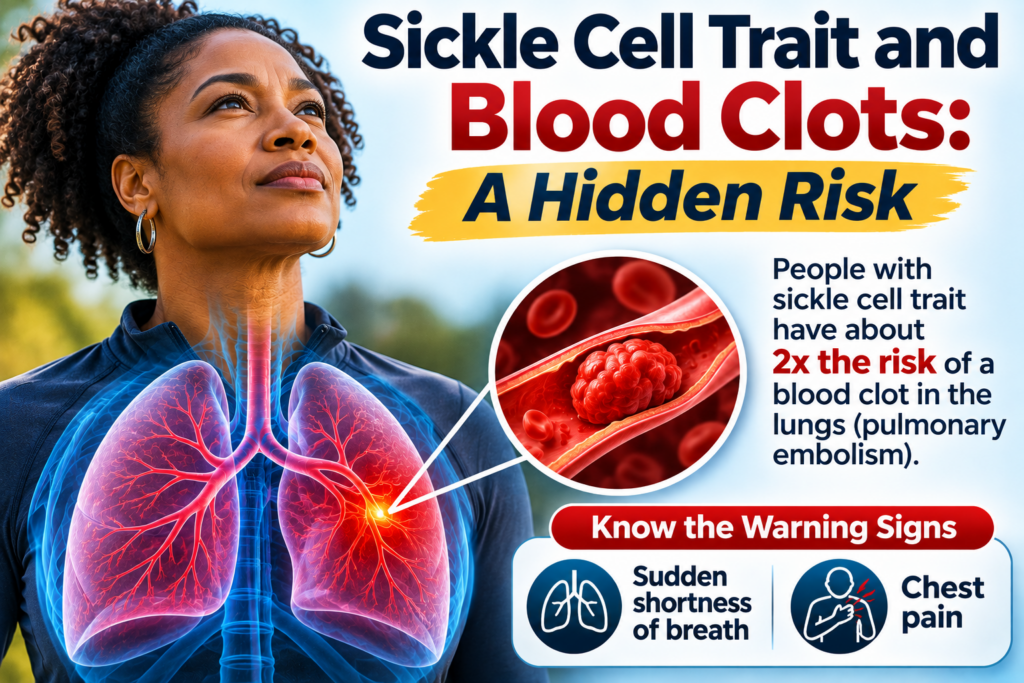
In the Atherosclerosis Risk in Communities (ARIC) study, African Americans with sickle cell trait had about twice the risk of pulmonary embolism, a blood clot in the lungs. A 2024 study of more than four million people found the trait raised the risk of blood clots in the veins by about 45%, and the effect held across every ancestry group studied.
The standard tools emergency doctors use to decide whether to look for a clot do not ask about sickle cell trait. A patient with the trait can “score low” and still have a clot.
What I recommend: Make sure your doctor knows your status before surgery, long recovery periods, or long trips, and before starting estrogen-containing birth control or hormone therapy. If you have sudden shortness of breath or chest pain, tell the emergency team you have the trait. I have also written about blood clots Black patients aren’t told about.
Exercise, heat, and the athlete question

Sickle cell trait has been linked to collapse and deaths in athletes and military recruits during extreme training. The NCAA and several branches of the military now screen for it.
The best data we have comes from a study of nearly 48,000 Black U.S. Army soldiers published in the New England Journal of Medicine. The trait raised the risk of exertional rhabdomyolysis (dangerous muscle breakdown during intense exercise) by 54%. But it did not raise the risk of death, in a population that follows strict precautions: gradual conditioning, water, and rest breaks.
That is the right message. The trait is not a reason to sit out. It is a reason to train smart.
What I recommend: Build intensity gradually. Hydrate before, during, and after. Take breaks in heat and humidity. Be cautious at high altitude. Stop for cramping, unusual weakness, or shortness of breath, and never “push through” a collapse.
An eye injury becomes an emergency
A blow to the eye can cause bleeding into the front chamber of the eye, called a hyphema. In people with sickle cell trait, sickled cells can clog the eye’s drainage system and send eye pressure soaring. In one series, 92% of patients with sickle hemoglobin had dangerously high eye pressure within 48 hours, compared with 19% of those without it.
Treatment changes too. Acetazolamide, a common pill used to lower eye pressure, is generally avoided in people with sickle hemoglobin because it can promote sickling.
What I recommend: Any eye injury with bleeding or blurred vision needs same-day eye care. Tell the doctor you have the trait.
Serious infections and acute illness
During the COVID-19 pandemic, a study of more than 130,000 veterans in the Million Veteran Program found that among people of African ancestry, sickle cell trait was linked to about 1.8 times the odds of dying from COVID-19 and to a higher risk of acute kidney failure. People with the trait also already had more kidney disease and more pulmonary embolism before they got sick.
The lesson reaches beyond COVID: when someone with the trait is seriously ill, dehydrated, or low on oxygen, their kidneys and blood need closer watching.
Even your blood donation is handled differently
Donated blood is routinely filtered to remove white blood cells. Blood from donors with sickle cell trait often clogs those filters or doesn’t filter completely. One 2022 study found that more than half of units from donors with the trait failed quality checks even when filtration looked successful.
People with the trait are still welcome donors. But it is one more example of how this “harmless” gene shows up in ordinary medical processes.
At a glance: where sickle cell trait changes care
| Area | What can happen | What to ask for |
|---|---|---|
| Diabetes testing | A1c reads about 0.3 points low | Fasting or 2-hour glucose, fructosamine, CGM |
| Kidneys | More albuminuria and CKD; poor urine concentration | Yearly uACR and eGFR; stay hydrated |
| Urine blood | Linked to renal medullary carcinoma in young people | Imaging, not reassurance |
| Blood clots | About 2x risk of pulmonary embolism | Clot-risk review before surgery, travel, hormones |
| Exercise and heat | Higher risk of muscle breakdown | Gradual training, water, rest breaks |
| Eye injury | Sharp rise in eye pressure after a hyphema | Same-day eye care; avoid acetazolamide |
| Serious illness | Higher risk of kidney failure and death in COVID-19 | Closer monitoring of kidneys and fluids |
The precision medicine connection
Mainstream guidance increasingly warns doctors not to use race in clinical decisions. I understand the concern. But sickle cell trait shows why ignoring ancestry can hurt the very people that guidance is meant to protect. I explain this tension in why health disparities exist if race is a social construct.
1. One gene variant, measurable consequences
Sickle cell trait comes from a single change in the beta-globin gene (the HbS variant). It is found in roughly 8% of African Americans: 7.9% of participants in the CARDIA and Jackson Heart analysis and 7.8% of veterans of African ancestry in the Million Veteran Program. It is less common, but present, in people with Hispanic, Mediterranean, Middle Eastern and South Asian roots. If we pretend ancestry doesn’t matter, we stop asking the question and stop testing. If we take ancestry seriously, we test, we know, and we treat the person in front of us more accurately.
2. Reading the labs correctly
For people with the trait, A1c should be paired with glucose testing. Kidney labs need care too. In 2021 the National Kidney Foundation and the American Society of Nephrology recommended a race-free eGFR equation and called for wider use of cystatin C, a second blood marker, to confirm kidney function because combining the two is more accurate. If you have the trait and your kidney numbers are borderline, a cystatin C test and a urine albumin test give a clearer picture than creatinine alone.
3. Genes stack up
Sickle cell trait rarely travels alone. About 13% of African Americans carry two high-risk APOL1 variants (13.6% in the Jackson Heart Study). G6PD deficiency affects more than 10% of African American men; a study of U.S. Army personnel found it in 12.2% of African American male soldiers. G6PD deficiency matters for medicines such as rasburicase, primaquine and dapsone, which can destroy red cells in people who have it. One person can carry one, two or all three of these variants. That is why genetic risk is a target, not destiny.
4. Medication and procedure safety
Knowing your status changes specific decisions: avoiding acetazolamide after an eye injury, weighing clot risk before estrogen-containing birth control or hormone therapy, and telling your surgical and anesthesia team before an operation so they can keep close watch on hydration and oxygen.
5. Knowing the limits
Sickle cell trait is not sickle cell disease, and most people with the trait live full, active lives. In the Army study, soldiers with the trait who followed standard precautions had no higher risk of death. The American Society of Hematology and other groups have raised concerns that mandatory screening can lead to stigma and discrimination. The point of testing is to guide care, not to limit anyone.
That is the promise of precision medicine for African Americans: not lowering the bar, but raising the level of detail. For patients and families, I cover these issues in Better Black Health. For clinicians, Precision Medicine for African Americans goes deeper.
Your action plan
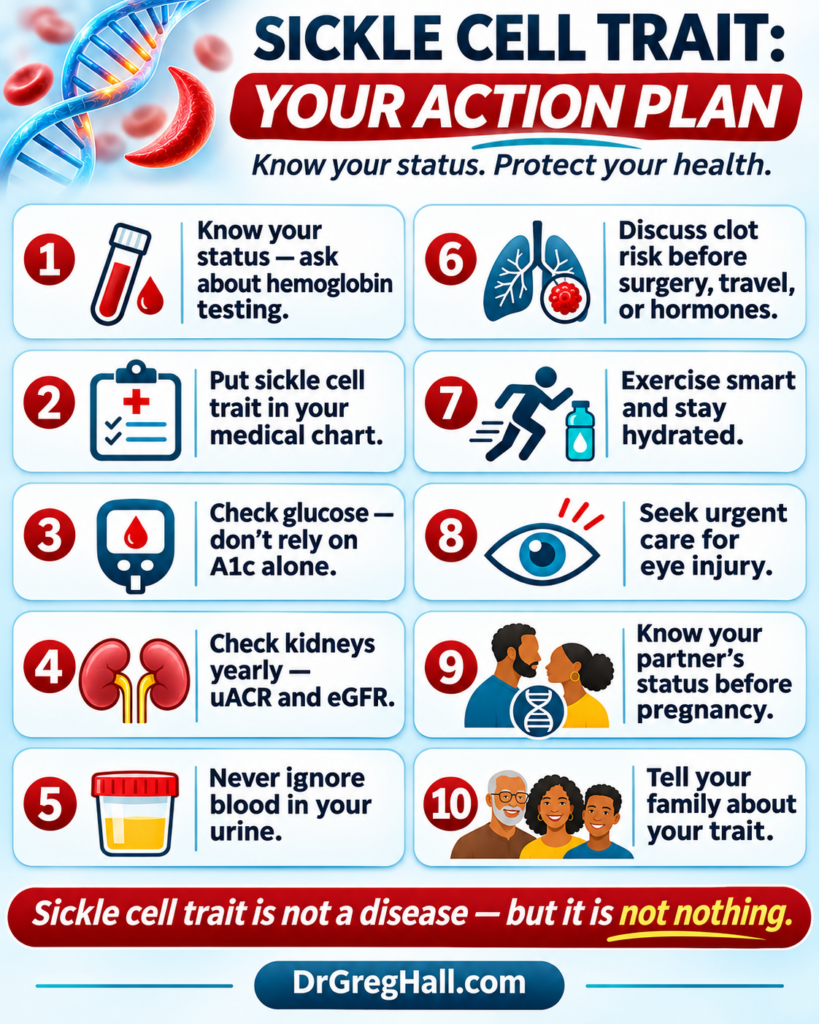
- Find out your status. Ask your doctor for a hemoglobin electrophoresis (or similar hemoglobin test). If you were born in the U.S. after the 1990s, your newborn screening result may be on file with your state.
- Get it on your chart. Ask that “sickle cell trait” be listed in your medical record so every doctor sees it.
- Don’t trust A1c alone. Pair it with glucose testing.
- Check your kidneys every year with a urine albumin test and eGFR.
- Never ignore blood in your urine.
- Talk about clot risk before surgery, long travel, or hormone therapy.
- Train smart and hydrate.
- Treat any eye injury as urgent.
- Plan your family with information. If you and your partner both carry the trait, each pregnancy has a 1 in 4 chance of a child with sickle cell disease. Partner testing gives you that knowledge before, not after.
- Tell your family. If you have the trait, a parent and possibly your siblings and children carry it too.
Sickle cell trait is not a disease. But it is not nothing. Knowing your status is one of the simplest, least expensive precision medicine steps any of us can take.
This article is for educational purposes only and does not constitute medical advice. Talk with your physician about your personal health.
References
- Lacy ME, et al. Association of sickle cell trait with hemoglobin A1c in African Americans. JAMA. 2017;317(5):507–515.
- Naik RP, et al. Association of sickle cell trait with chronic kidney disease and albuminuria in African Americans. JAMA. 2014;312(20):2115–2125.
- Olaniran KO, et al. Kidney function decline among Black patients with sickle cell trait and sickle cell disease. J Am Soc Nephrol. 2020.
- Hicks PJ, et al. Sickle cell trait is not independently associated with susceptibility to end-stage renal disease in African Americans. Kidney Int. 2011;80(12):1339–1343.
- Young BA, et al. APOL1, sickle cell trait, and CKD in the Jackson Heart Study. Kidney Med. 2021;3(6):962–973.
- Clinical characteristics, management, and outcomes of patients with renal medullary carcinoma: 135 patients. Eur Urol Oncol. 2025;8(2):315–323.
- Folsom AR, et al. Prospective study of sickle cell trait and venous thromboembolism incidence. J Thromb Haemost. 2015;13(1).
- Lin KH, et al. Sickle cell trait and venous thromboembolism across ancestries. Blood Adv. 2024.
- Nelson DA, et al. Sickle cell trait, rhabdomyolysis, and mortality among U.S. Army soldiers. N Engl J Med. 2016;375(5):435–442.
- Verma A, et al. Kidney comorbidities and acute kidney failure with unfavorable outcomes after COVID-19 in individuals with the sickle cell trait. JAMA Intern Med. 2022;182(8):796–804.
- Delgado C, et al. A unifying approach for GFR estimation: recommendations of the NKF-ASN Task Force on reassessing the inclusion of race in diagnosing kidney disease. J Am Soc Nephrol. 2021.
- Chinevere TD, et al. Prevalence of glucose-6-phosphate dehydrogenase deficiency in U.S. Army personnel. Mil Med. 2006;171(9):905–907.
- Gehrie EA, et al. Sickle cell trait results in a high leukoreduction quality control failure rate for whole blood donations. Transfusion. 2022.