

The short answer: Two of the most commonly prescribed blood thinners in America, warfarin (Coumadin) and clopidogrel (Plavix), are dosed using genetic tests that were built around European patients. The gene variants that matter most in people of African ancestry are missing from most of those tests. If you are Black and taking either drug, that gap is worth a conversation with your doctor.
I have written before about why Black Americans carry a higher baseline risk of blood clots in Blood Clots in the Hospital and After a Cancer Diagnosis. This article picks up where that one leaves off. Once you are actually on a blood thinner, ancestry starts to affect how much of the drug you need, and whether it works at all.
Before anything else: never change or stop a blood thinner on your own. Stopping these drugs abruptly can cause a stroke, a heart attack, or a clot. Everything below is meant to help you ask better questions, not to adjust your own dose.
Why clotting risk runs higher in Black Americans
This is the part of the story that mainstream guidance tends to tiptoe around, so let me say it plainly. The overall incidence of venous thromboembolism, meaning clots in the legs and lungs, is 30% to 60% higher in Black Americans than in white Americans, and it holds across age groups and in both men and women.1
The biology behind it is not mysterious. Black Americans tend to have the highest levels of factor VIII, von Willebrand factor, and D-dimer compared with white, Hispanic, and Chinese populations.2 Those are clot-promoting proteins. Higher levels mean a system that is primed to clot.
The usual response is that this is all explained by obesity, diabetes, kidney disease, and poverty. Those matter. But a large Veterans Affairs study of more than 142,000 hospitalized patients found the VTE gap held steady even after adjusting for social deprivation index, blood type, and surgery type.3 The gap did not disappear when the social factors were accounted for. Something biological is contributing, and pretending otherwise does not help the patient in front of me.
There is also an ancestry-specific factor that standard testing ignores entirely. Sickle cell trait, present in about 1 in 13 Black babies born in the United States, is associated with about a two-fold increased risk of pulmonary embolism, though not of DVT alone.4 Most people with the trait have never been told it carries any risk at all. I wrote about that in Sickle Cell Trait Is Not “Just a Trait”.
Higher clotting risk means more Black patients end up on blood thinners. Which makes it worse that the dosing science underneath those drugs was not built with us in mind.

Warfarin: the dosing tests look in the wrong place
Warfarin is notoriously hard to dose. Too little and you clot. Too much and you bleed. So genetic testing was supposed to solve this, by checking two genes, CYP2C9 (how fast you break the drug down) and VKORC1 (how sensitive you are to it).
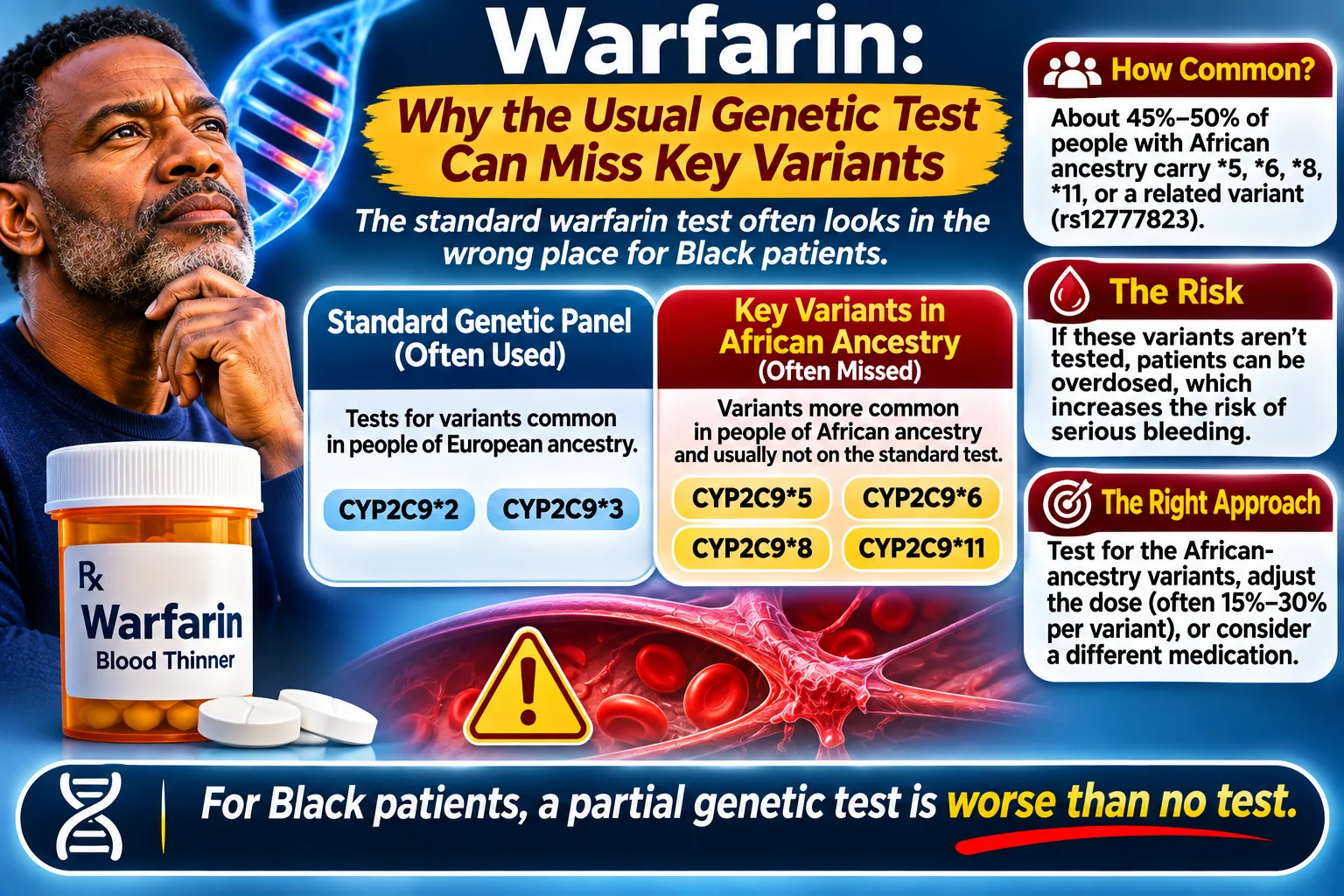
Here is the problem. The standard panels test for CYP2C9*2 and *3, which are the common reduced-function variants in people of European ancestry. The variants that matter most in people of African ancestry, CYP2C9*5, *6, *8, and *11, occur almost exclusively in persons of African ancestry and are collectively more common in that population than *2 and *3.5 They are usually not on the panel.
This is not a small gap. The Clinical Pharmacogenetics Implementation Consortium, the body that writes the pharmacogenetic dosing guidelines, notes that 45% to 50% of individuals with self-reported African ancestry carry CYP2C9*5, *6, *8, *11, or a related variant called rs12777823.5 Roughly half of us carry something the standard test does not look for.
What happens when you dose from an incomplete test? In the COAG trial, these variants were not genotyped, and their absence likely led to significant overdosing in patients with these alleles.5 A separate analysis concluded that omitting them was a major reason genotype-guided dosing performed poorly in African Americans.6 Overdosing a blood thinner means bleeding.
CPIC’s response was blunt, and I think correct. The guideline recommends against pharmacogenetic dosing of warfarin in Black patients when only CYP2C9*2 and *3 results are available.5 In plain terms: a partial genetic test is worse than no genetic test. If the African-ancestry variants were not checked, the guideline says to dose warfarin clinically instead.
When the right variants are tested and found, the adjustments are substantial. CPIC advises decreasing the calculated dose by 15% to 30% per variant allele, or considering a different drug altogether, and a further 10% to 25% reduction for carriers of the rs12777823 variant.7
One important caveat, and CPIC makes it explicitly: these are commonly called African-specific alleles, but they can occur in people who do not identify as, or know of, their African ancestry.7 Ancestry is a clue about which variants are likely. It is not a substitute for testing the right ones.
Plavix: the drug has to be switched on first
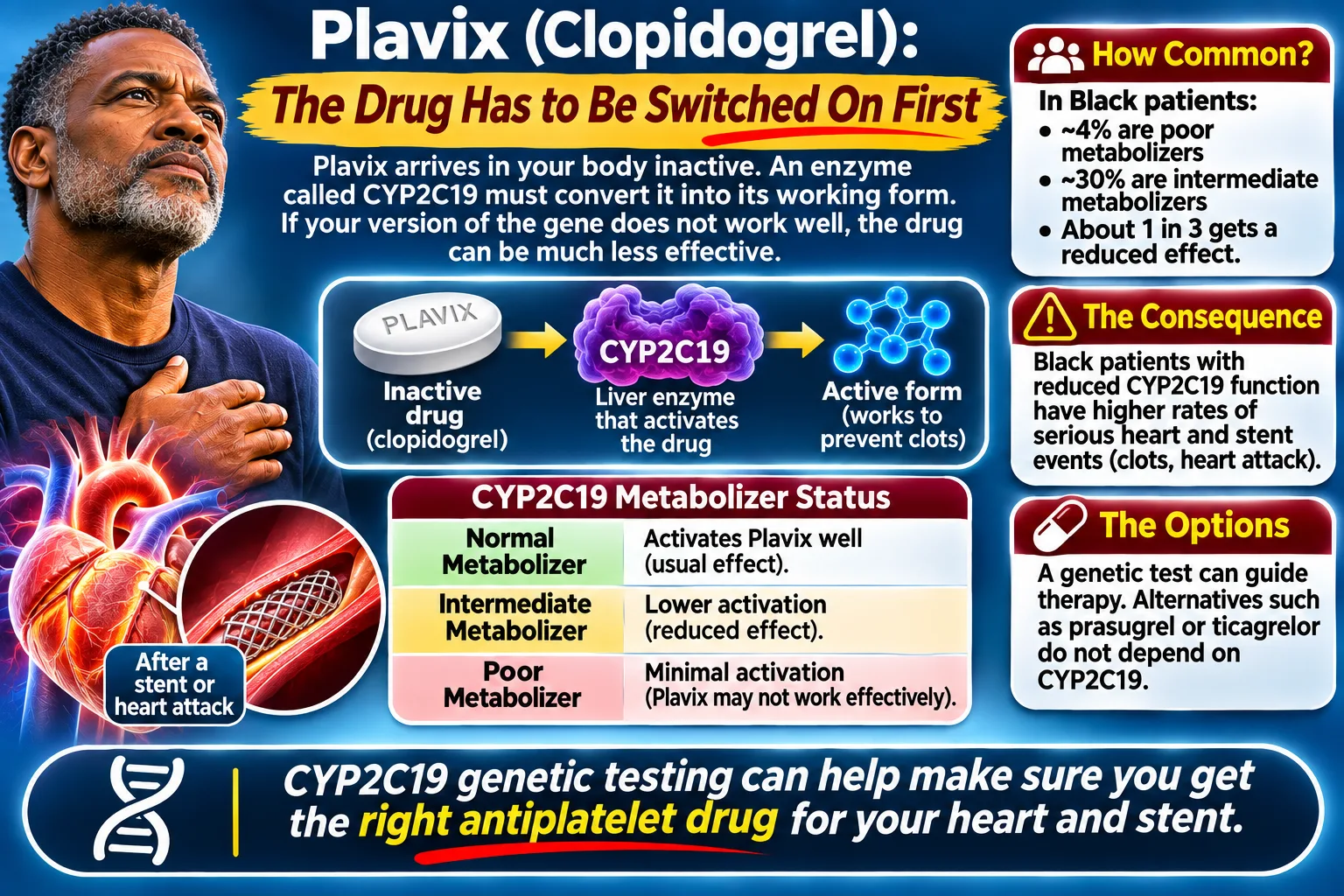
Clopidogrel, sold as Plavix, works differently. It arrives in your body inactive. An enzyme called CYP2C19 has to convert it into its working form. If your version of that gene does not do the job well, you are swallowing a pill that is doing much less than you and your doctor believe.
The relevant numbers for us: about 4% of African Americans are CYP2C19 poor metabolizers, and roughly 30% of people of African descent are intermediate metabolizers.8 Taken together, that is about a third of Black patients getting a reduced effect from a drug often prescribed after a stent or a heart attack.
Unlike warfarin, this is not a story about missing variants. The main loss-of-function variant, CYP2C19*2, is tested on standard panels and runs at a similar frequency in European and African populations.8 The gap here is that the test is often simply not ordered.
And the consequences were specifically confirmed in Black patients. A 2024 study across five institutions found that self-identified Black patients with intermediate or poor metabolizer status who were treated with clopidogrel after a stent procedure had significantly higher rates of major atherothrombotic events.9 Alternatives such as prasugrel and ticagrelor do not depend on this enzyme, so a genotype result can change the prescription.
A word about vitamin K and your supplements
If you take warfarin, vitamin K directly opposes the drug. A sudden change in your vitamin K intake, including starting a supplement that contains it, can swing your INR and your bleeding risk.
This is one reason GNetX Sequence has never contained added vitamin K. I explain that reasoning more fully in Vitamin K2, Vitamin D3, and Black Health. Whatever supplement you take, tell your doctor and keep your intake steady rather than starting and stopping.
What to ask your doctor
- If you are on warfarin: “Was I genetically tested, and did the test include CYP2C9*5, *6, *8, and *11?” If only *2 and *3 were run, the guideline says to dose clinically rather than trust the partial result.
- If you are on Plavix: “Have I had CYP2C19 genotyping?” Especially after a stent or heart attack.
- If your INR has been hard to control: Ask whether ancestry-relevant variants could be part of the reason, instead of assuming you are simply non-compliant.
- If you have sickle cell trait: Make sure it is in your chart and raised before surgery or a long hospital stay.
- Before any supplement: Bring the actual bottle to your visit.
The precision medicine connection
This is precision medicine in its most practical form. Not a distant promise, but two of the most prescribed drugs in the country, today.
1. The reference population was never us
Warfarin dosing algorithms were derived largely from patients of European ancestry, and the panels that feed them omit the variants that matter most in African-ancestry patients.6 The tool is not broken. It was calibrated on a population that does not include you.
2. A partial test can be worse than none
This is the counterintuitive lesson. A CYP2C9*2/*3 result in a Black patient looks like data, and it gets treated like data, when CPIC says it should not guide dosing at all.5 Precision medicine done halfway is not precision. It is false confidence.
3. Average doses differ by ancestry
The daily warfarin dose needed to reach a stable therapeutic INR averages about 5.1 mg in patients of European ancestry, 5.7 mg in African ancestry, 4.4 mg in Latino patients, 3.4 mg in Asian ancestry, and 4.5 mg in American Indian/Alaska Native patients.10 These are population averages, not your dose. But they show that a one-size-fits-all starting point is a guess.
4. Ancestry points; testing confirms
Ancestry tells us which variants are worth checking. It does not tell us what any individual carries, and CPIC is clear that these alleles turn up in people with no known African ancestry.7 I argue for using ancestry more than current guidance prefers, and this is exactly why: used correctly, it makes the testing sharper, not sloppier.
5. Risk and treatment have to be considered together
Black Americans clot more and are therefore more likely to be on these drugs, yet the dosing science is weakest for us. That is the gap. Closing it is what precision medicine is actually for.
References
- Buckner TW, Key NS. Venous thrombosis in blacks. Circulation. 2012;125(6):837–839.
- Xu Y, Siegal DM, Anand SS. Ethnoracial variations in venous thrombosis: implications for management, and a call to action. J Thromb Haemost. 2021;19(1):30–40.
- Lin MS, Sahoo S, Hayssen H, et al. Evaluation of factors underlying differences in venous thromboembolism rates between Black and White patients. J Vasc Surg Venous Lymphat Disord. 2025;13(5):102270.
- Folsom AR, Tang W, Roetker NS, et al. Prospective study of sickle cell trait and venous thromboembolism incidence. J Thromb Haemost. 2015;13(1):2–9.
- Johnson JA, Caudle KE, Gong L, et al. CPIC Guideline for Pharmacogenetics-Guided Warfarin Dosing: 2017 Update. Clin Pharmacol Ther. 2017;102(3):397–404.
- Drozda K, Wong S, Patel SR, et al. Poor warfarin dose prediction with pharmacogenetic algorithms that exclude genotypes important for African Americans. Pharmacogenet Genomics. 2015;25(2):73–81.
- Warfarin response: therapeutic recommendations. NIH Genetic Testing Registry.
- Dean L. Clopidogrel therapy and CYP2C19 genotype. Medical Genetics Summaries. NCBI.
- Tunehag KR, Thomas CD, Franchi F, et al. CYP2C19 genotype is associated with adverse cardiovascular outcomes in Black patients treated with clopidogrel undergoing PCI. J Am Heart Assoc. 2024;13(12):e033791.
- Kaye JB, Schultz LE, Steiner HE, et al. Warfarin pharmacogenomics in diverse populations. Pharmacotherapy. 2017;37(9):1150–1163.