

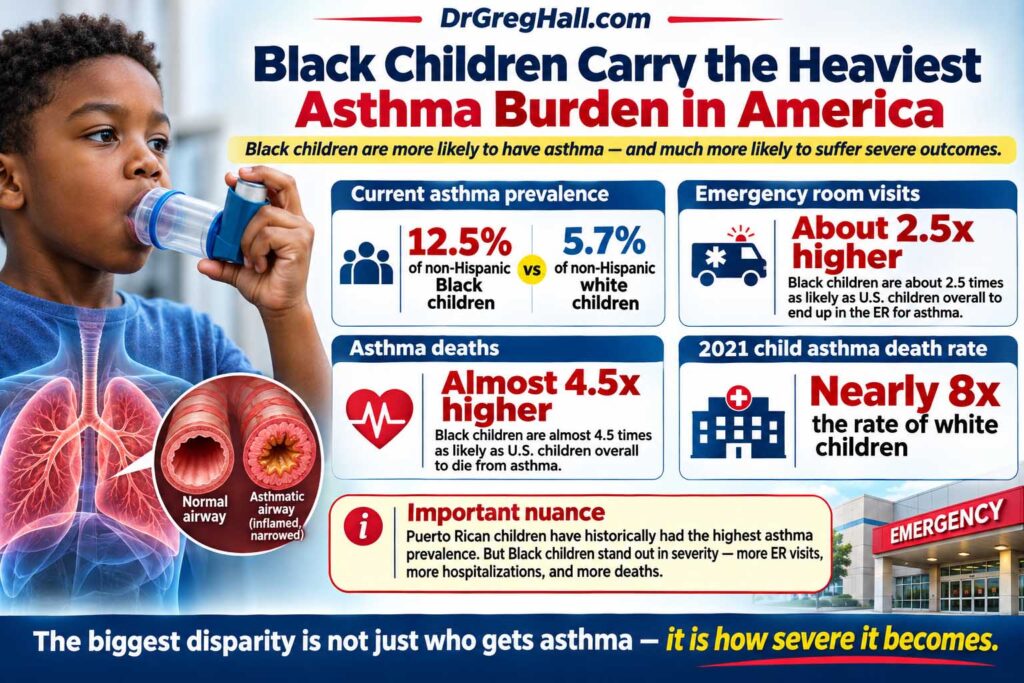
Black children in the United States are about twice as likely to have asthma as white children, and far more likely to die from it.
CDC surveillance puts current asthma at 12.5% of Black children compared with 5.7% of white children.[1] Federal data show Black children are about two and a half times as likely to end up in an emergency room for asthma, and almost four and a half times as likely to die from it, compared with U.S. children overall.[2]
Here is the part that should bother all of us. The gap in how often children get asthma is roughly two to one. The gap in how badly it goes is far wider. That tells you the problem is not only who develops asthma. It is what happens after a child is diagnosed and handed an inhaler.
Two kinds of inhaler, and why nobody explains the difference
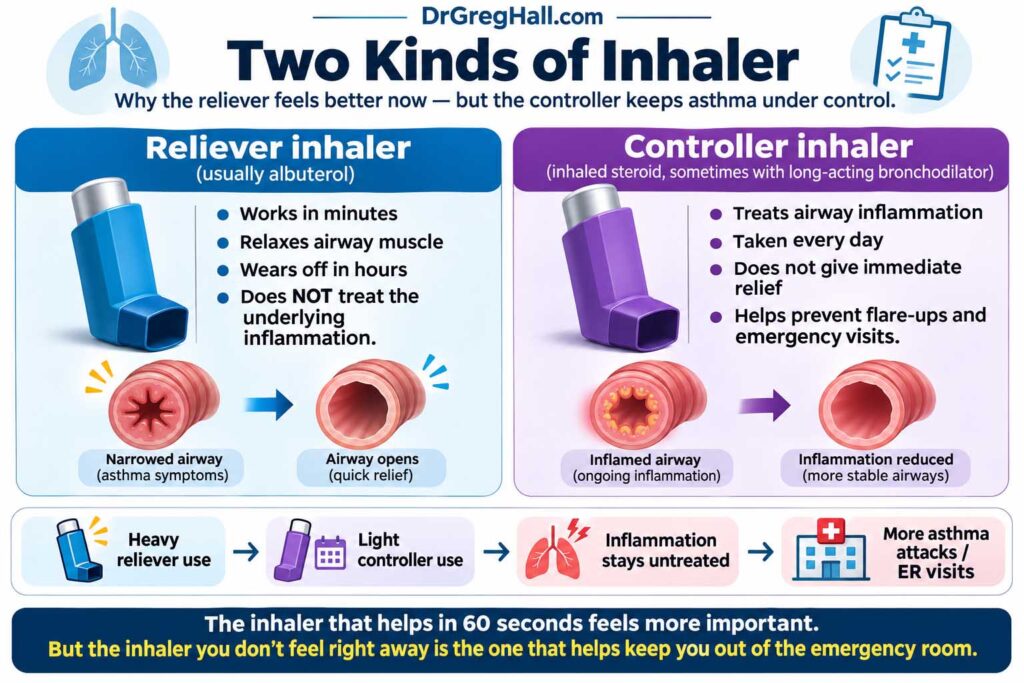
Most people with asthma leave the office with two inhalers and very little explanation of why they are different.
The reliever — usually albuterol, often the blue one — relaxes the muscle wrapped around your airways. It works in minutes. It wears off in hours. It does nothing about the underlying inflammation.
The controller — an inhaled steroid, sometimes combined with a long-acting bronchodilator — treats the inflammation that makes your airways twitchy in the first place. It does nothing for you in the moment. Which is exactly why people stop taking it.
That asymmetry drives a predictable pattern: heavy reliever use, light controller use, and inflammation that never gets treated. Nobody is being careless. The inhaler that helps you breathe in sixty seconds will always feel more necessary than the one that does nothing you can feel. But the second one is what keeps you out of the emergency room.
Your inhaler is not the problem — the guidelines were
You may have heard that albuterol does not work as well in Black patients. I want to be careful here, because the research does not support that, and I am not going to tell you it does.
What the research does show is more troubling. The treatment plans built around albuterol were designed and tested in groups that included very few Black patients. When researchers finally ran those trials properly, the guidelines did not hold up.
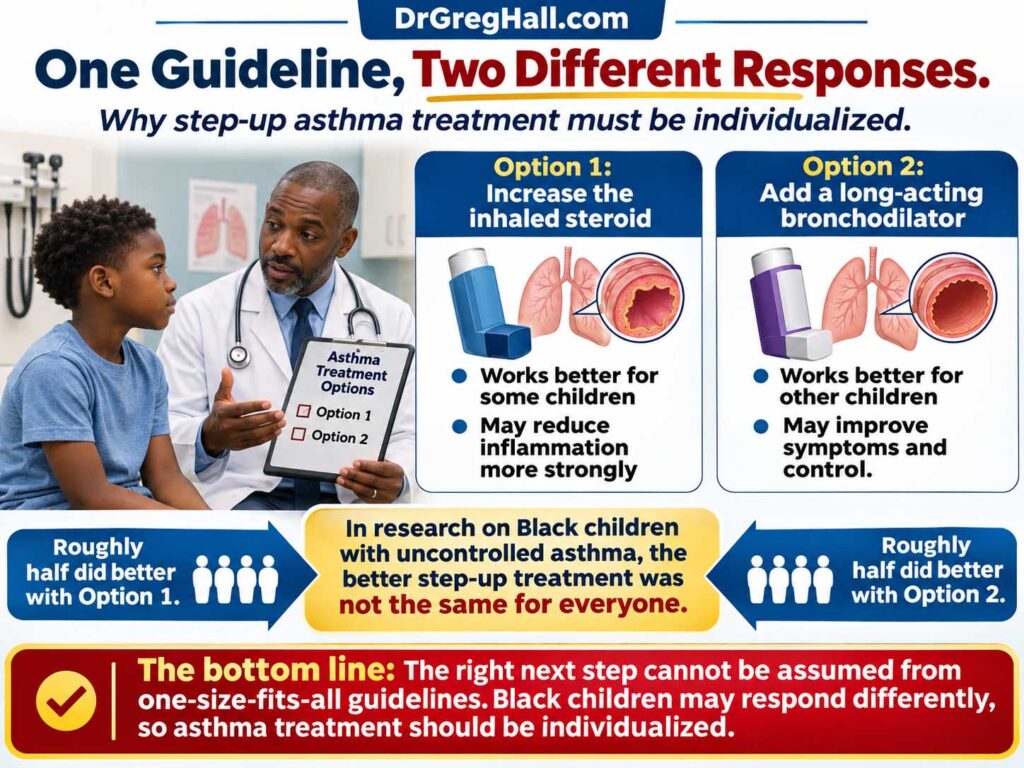
Standard guidance says that when low-dose steroids are not controlling asthma, add a long-acting bronchodilator rather than raise the steroid dose. An NHLBI trial tested that in Black patients and found almost half of Black children did better with more inhaled steroid and almost half did better with the added bronchodilator — a near-even split, and a different pattern than in adults.[3] There was no single right answer for Black children as a group. You cannot predict it from race. You have to try it and watch.
Then there is the safety lesson. In 2003, a trial of more than 26,000 patients was stopped early because of asthma deaths concentrated among African American participants.[4] The deaths clustered among people taking a long-acting bronchodilator without an inhaled steroid. Paired with a steroid, later trials found it safe. Unopposed bronchodilation was the danger — and Black patients paid for that lesson.
Finally, the fix. In 2022, a trial of 1,201 Black and Latinx adults asked half of them to take a puff of inhaled steroid every time they reached for their reliever. One instructional visit, no other change. That group had fewer severe asthma attacks.[5] One instruction, delivered once. That is what had been missing.
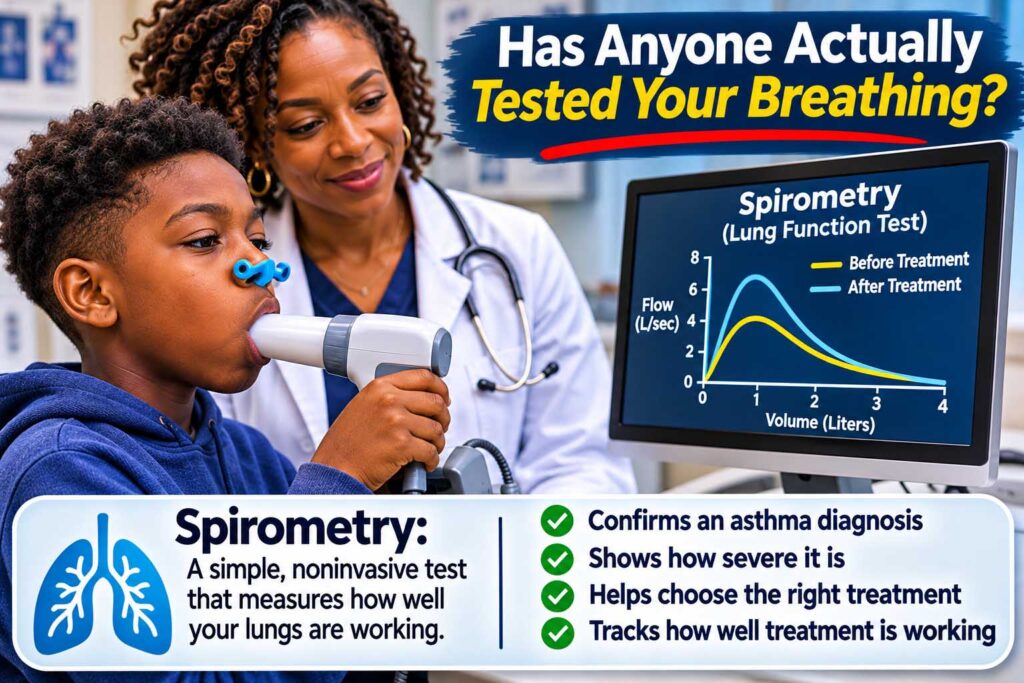
Before any of that: has anyone actually tested your breathing?
There is a step that gets skipped far more often than you would guess.
Asthma is supposed to be confirmed with spirometry — a breathing test. In a study of 134,208 patients diagnosed with asthma, only 47.6% had spirometry within a year of diagnosis, and 78.3% were prescribed asthma medication even without it.[6] A great many people are diagnosed and medicated on symptoms alone.
Whether you get tested depends mostly on who you see. Specialists ordered spirometry for 80.1% of their asthma patients; primary care physicians, 23.3%.[6] Among Medicaid-enrolled children, 80.8% were tested when seen by an allergy specialist and 18.1% when not.[7]
That matters because Black children are markedly less likely to reach a specialist. In the Military Health System, where every family is insured, white children with asthma saw a specialist more often than Black or Hispanic children — 12.9% versus 9.6% — while Black children had more asthma hospitalizations and emergency visits.[8] Insurance alone did not close it. More recent work found fewer than 2 in 10 children with poorly controlled asthma had seen a pulmonologist or allergist in the past year; Black children were 58% of that group but only 39% of those who had ever received specialty care.[9]
I will be straight with you. I cannot show that Black patients are refused breathing tests — the one study that looked hardest at this did not find a racial difference in who got tested.[10] What it shows is that Black children are less often in the setting where testing is routine. The result is the same.
The lever is simple. A referral from the primary care doctor raised the odds of actually seeing a specialist more than tenfold.[9] Somebody has to write it. You are allowed to ask.
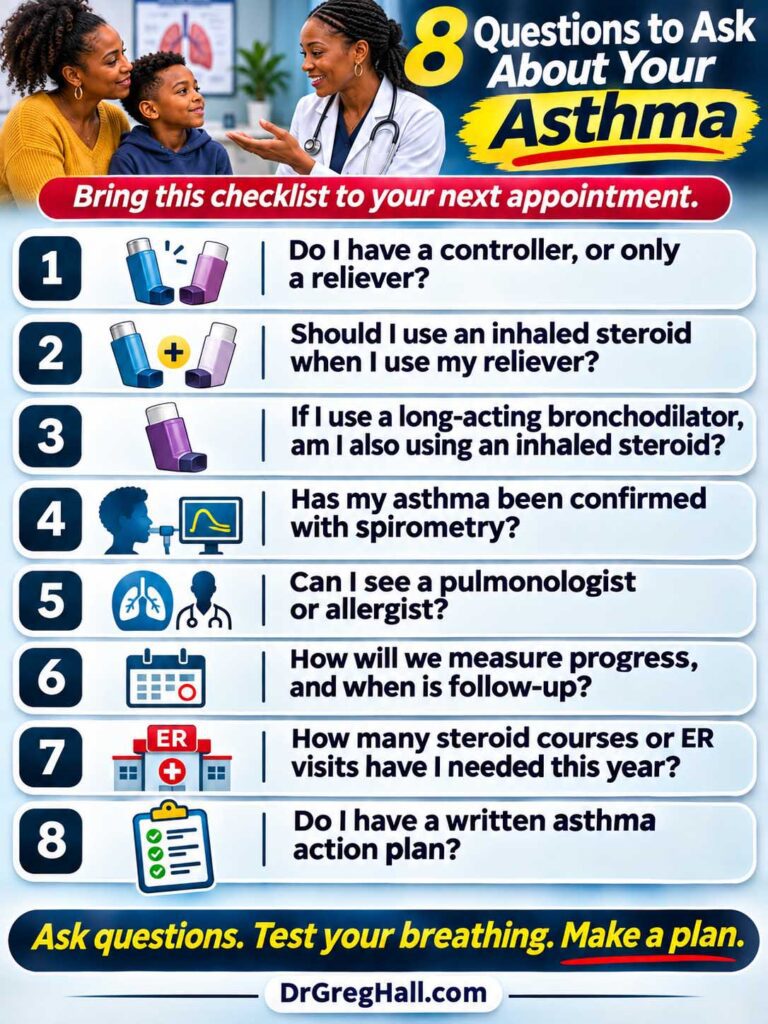
Eight questions to ask at your next appointment
None of these require you to argue about genetics. Bring them anyway.
- Am I on a controller, or only a reliever? If the only inhaler you have is the quick-relief one, that is the most important thing to change today.
- Should I take my steroid inhaler whenever I use my reliever? Ask specifically. This approach is newer than many patients’ treatment plans.
- If I am on a long-acting bronchodilator, am I also on an inhaled steroid? It should not be running unopposed. If it is, that is a conversation for now, not next year.
- Has my asthma diagnosis ever been confirmed with a breathing test? If nobody has measured your breathing, nobody has confirmed the condition you are being treated for.
- Can I get a referral to a pulmonologist or allergist? This single question does double duty. It is the route to a specialist and, in practice, the route to getting tested.
- How will we know if this is working, and when are we checking? Response has to be measured in you, not assumed from a guideline. That means a scheduled follow-up, not just a refill.
- How many times have I needed oral steroids or an emergency visit this year? This is the number that predicts trouble. Count it before you go in.
- Do we have a written action plan? You should know what to do when symptoms start, not just what to take every day.
Here is that same list as one image. Save it or screenshot it, and bring it with you.
The bottom line
Black children are about twice as likely to have asthma as white children and several times more likely to die from it. That gap is real and unacceptable. But it is not because albuterol is a weaker drug in Black bodies.
It is because the treatment strategies built around it were developed without Black patients in the room — and when they were finally tested, they did not perform as predicted. The lesson is not that Black patients need different drugs. It is that they needed to be studied, and were not.
That is the case for precision medicine, and it is a stronger case than the genetic one. Study populations properly. Test the person in front of you instead of assuming from a label. I make this argument at greater length in why health disparities persist even though race is a social construct.
An inhaler is not a small thing. For a child with asthma, it is the difference between an ordinary night and an emergency room. Getting the right one into the right hands is a solvable problem. We have been slow about solving it for the children who need it most.
For more on asking better questions about your own care, see my book Better Black Health.
References
- Centers for Disease Control and Prevention. The status of asthma in the United States. Prev Chronic Dis. 2024. cdc.gov
- U.S. Department of Health and Human Services, Office of Minority Health. Asthma and Black/African Americans. minorityhealth.hhs.gov
- Wechsler ME, Szefler SJ, Ortega VE, et al. Step-up therapy in Black children and adults with poorly controlled asthma. N Engl J Med. 2019;381(13):1227-1239. doi.org/10.1056/NEJMoa1905560
- Nelson HS, Weiss ST, Bleecker ER, Yancey SW, Dorinsky PM. The Salmeterol Multicenter Asthma Research Trial. Chest. 2006;129(1):15-26.
- Israel E, Cardet JC, Carroll JK, et al. Reliever-triggered inhaled glucocorticoid in Black and Latinx adults with asthma. N Engl J Med. 2022;386(16):1505-1518. doi.org/10.1056/NEJMoa2118813
- Sokol KC, et al. Choosing wisely: adherence by physicians to recommended use of spirometry in the diagnosis and management of adult asthma. Am J Med. sciencedirect.com
- Association of allergy specialty care and asthma outcomes for Medicaid-enrolled children. pmc.ncbi.nlm.nih.gov
- Differences in prevalence, treatment, and outcomes of asthma among a diverse population of children with equal access to care: findings from a study in the Military Health System. JAMA Pediatr. jamanetwork.com
- Pediatric asthma specialist care utilization among marginalized children with poorly controlled asthma. J Asthma. 2025. doi.org/10.1080/02770903.2025.2581016
- Spirometry utilization among patients with asthma. J Asthma Allergy. 2020. doi.org/10.2147/JAA.S254431