
Cannabis Hyperemesis Syndrome and Black Health
New national data from the CDC show that Black Americans now have the highest emergency room rate of cannabinoid hyperemesis syndrome of any large racial group in the country: about 1.7 times the rate among White Americans.
Cannabinoid hyperemesis syndrome, or CHS, is a condition in which long-term, frequent marijuana use causes repeated bouts of severe nausea, vomiting and belly pain. Some people call it “scromiting,” because the vomiting can be so violent that people scream. It sounds backwards. Many people use marijuana to calm their stomach. But for a growing number of regular users, the same drug ends up causing the very sickness they thought it would prevent.
The typical story goes like this. A young adult comes in for the third or fourth time in a year, dehydrated and doubled over. He has had a CT scan, blood work, maybe an endoscopy. Nobody has asked him how much he smokes, or he has not connected the two. In my view, CHS is one of the most under-discussed health issues in our community right now, and the numbers are starting to prove it.
What CHS looks like
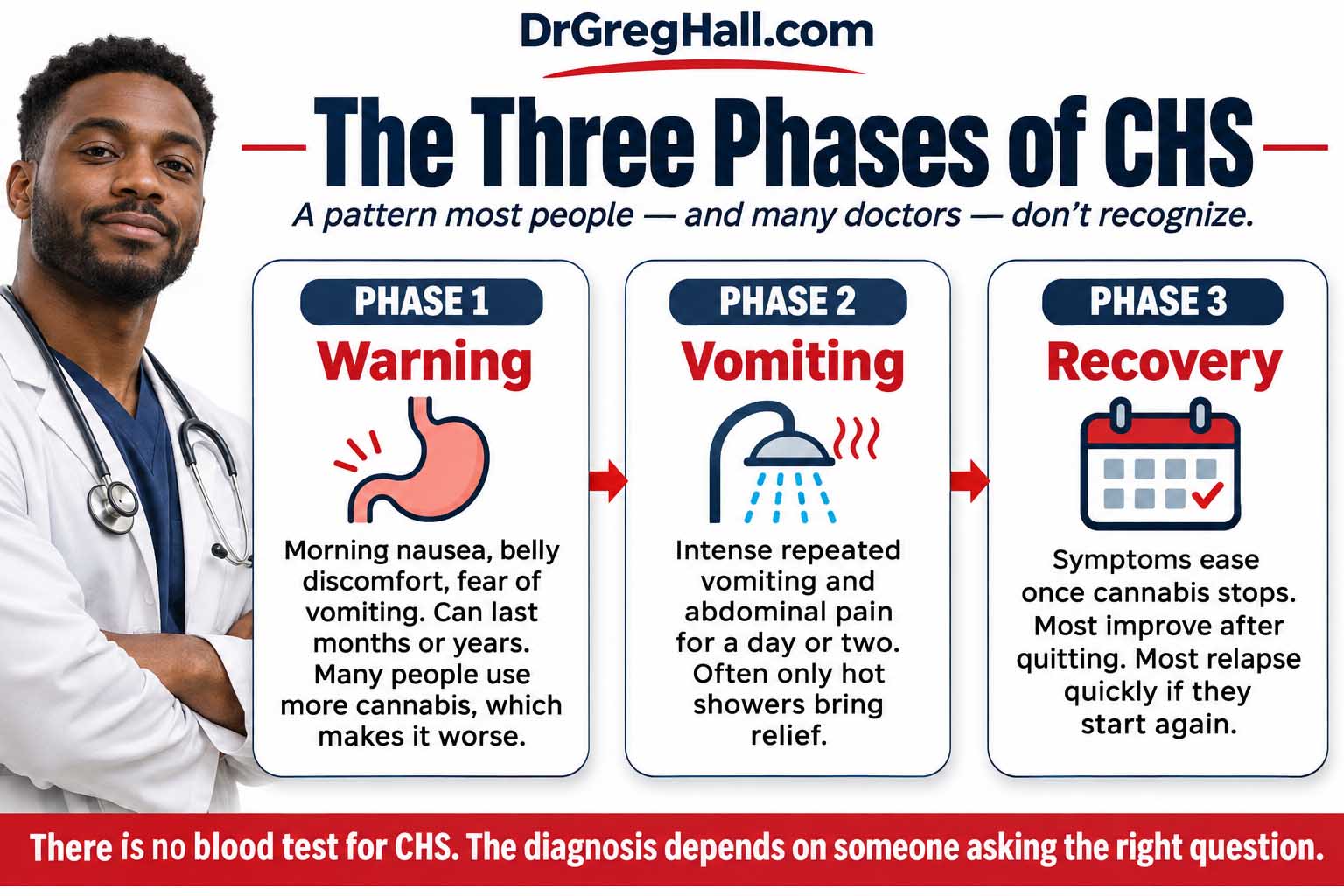
CHS follows a recognizable pattern: years of frequent use, then cycles of vomiting that standard nausea medicines don’t fix, relieved only by long hot showers. Doctors usually describe three phases:
- The warning phase. Morning nausea, belly discomfort and a fear of vomiting. This can last months or years, and many people respond by using more cannabis, which makes things worse.
- The vomiting phase. Intense, repeated vomiting and abdominal pain, often for a day or two at a time. Many people find that only hot showers or baths bring relief, sometimes for hours.
- The recovery phase. Symptoms ease once cannabis is stopped. Most people improve after quitting, and most relapse quickly if they start again.
CHS is not harmless. The most common complications are dehydration, low potassium and acute kidney injury. Rarely, violent vomiting can tear the esophagus or cause electrolyte problems that trigger seizures or dangerous heart rhythms.
There is no blood test for CHS. It is a diagnosis made by ruling other things out and by asking the right question about cannabis use. In the emergency room, the usual nausea drugs often fail. Haloperidol and capsaicin cream rubbed on the abdomen are commonly used, and opioid pain medicines should be avoided. But the only lasting cure is stopping cannabis.
What the numbers show
In October 2025, CHS finally got its own diagnosis code — R11.16 in the ICD-10-CM system. That let the CDC count it properly for the first time, and the August 2026 report is the clearest national picture we have. From October 2025 through May 2026, Black Americans had about 27,000 CHS-related emergency visits, roughly 29% of all cases where race was recorded, though we are about 14% of the population.
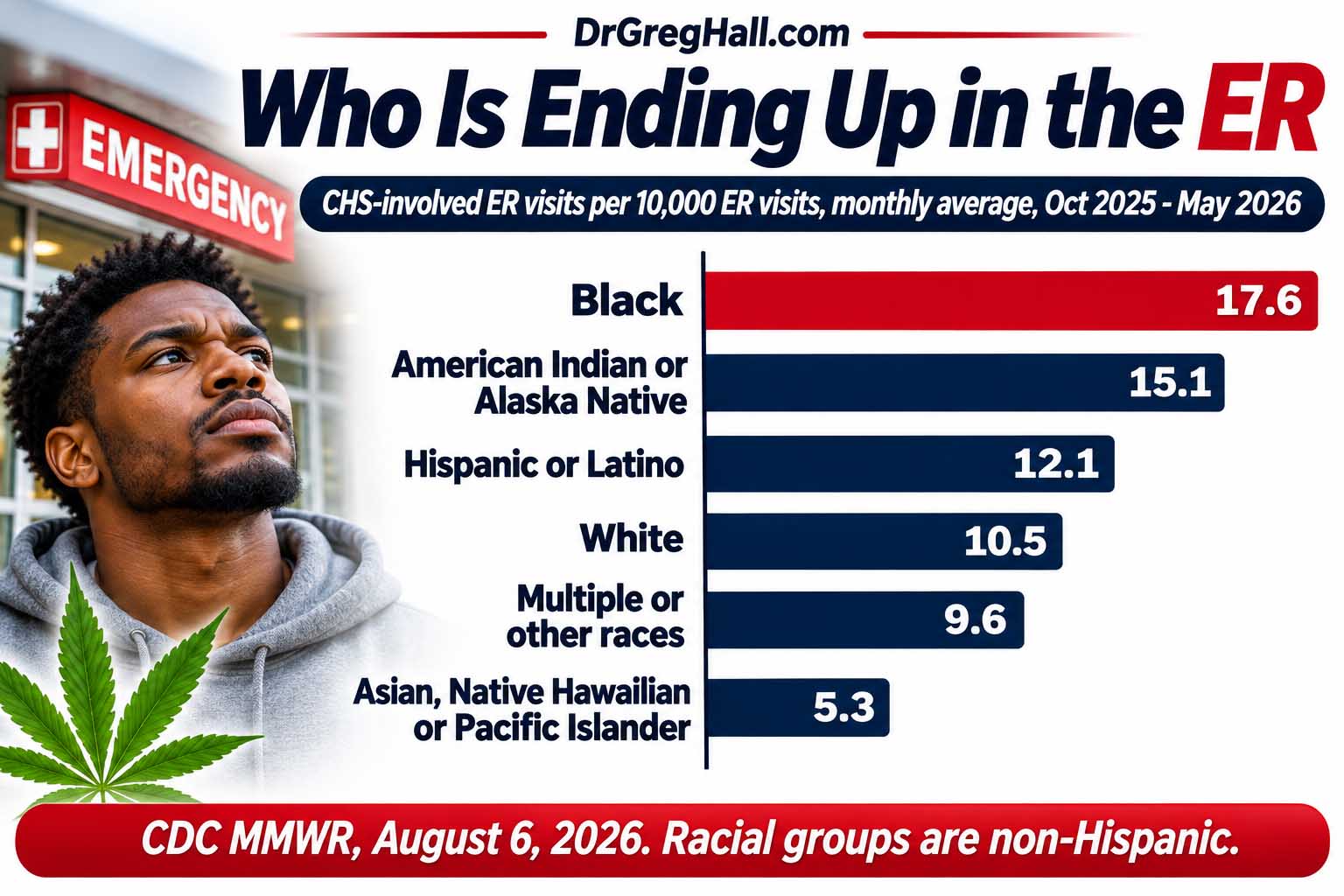
| Group | Rate per 10,000 ER visits | CHS visits |
|---|---|---|
| Black | 17.6 | 27,000 |
| American Indian/Alaska Native | 15.1 | 902 |
| Hispanic/Latino | 12.1 | 16,653 |
| White | 10.5 | 43,281 |
| Multiple/other races | 9.6 | 3,255 |
| Asian/Native Hawaiian/Pacific Islander | 5.3 | 989 |
Other studies point the same way:
- CHS is rising fast overall. A national study of more than 188 million ER visits found CHS grew roughly fivefold from 2016 to 2022, from 4.36 to 22.33 per 100,000 ER visits, peaking during the COVID-19 pandemic, with the highest risk at ages 18 to 25.
- Massachusetts saw the same racial pattern. Across more than 15 million ER visits from 2012 to 2021, the highest 10-year rates were among young adults, Hispanic and Black patients, and men.
- Black patients are over-represented, though modestly. In that same 188-million-visit national study, Black patients made up 24.7% of CHS visits but 19.9% of comparison visits — a small but statistically significant elevation. A separate review of more than 300,000 CHS patients in electronic health records found 27.5% were Black, with anxiety and depression among the most common other diagnoses.
- Young people are hit hardest. In the CDC data, people aged 15 to 24 had the highest rate of any age group — 38.7 per 10,000 ER visits, more than triple the overall average of 12.0.
One caution, and it is a large one. The CDC says part of the recent jump reflects better recognition under the new code, not only more illness. The rate went from 3.2 CHS visits per 10,000 ER visits before the code to 12.0 after — a 3.7-fold jump in eight months, which no real change in disease could produce that fast. CHS was being missed before. Now we are starting to see it.
Why Black Americans are showing up more
The data do not yet explain the gap, but several factors likely work together.
Use patterns differ. Black adults are more likely than White adults to use marijuana in some national samples. A 2025 national study found Black adults who use cannabis have about twice the odds of smoking it and lower odds of using edibles than White users. Blunts are common, and daily blunt use is a marker of dependence. Today’s products are also far more potent than the marijuana of a generation ago, which raises the dose a daily user actually receives.
Dispensaries cluster in our neighborhoods. A 2025 study in the American Journal of Preventive Medicine, covering 5,586 retailers across 18 legal states, found that neighborhoods with high concentrations of low-income Black residents had 2.53 times as many cannabis retailers as high-income, mostly White neighborhoods. For low-income Hispanic neighborhoods the figure was slightly higher, 2.67 times. We have seen this pattern before with liquor stores and tobacco shops. Ohio began legal adult-use sales in 2024, so this matters here at home.
The emergency room is often the doctor’s office. Families without a steady primary care doctor are more likely to bring recurring symptoms to the ER. That raises ER counts, and it also means the person is seen by a different clinician each time, with no one connecting the visits.
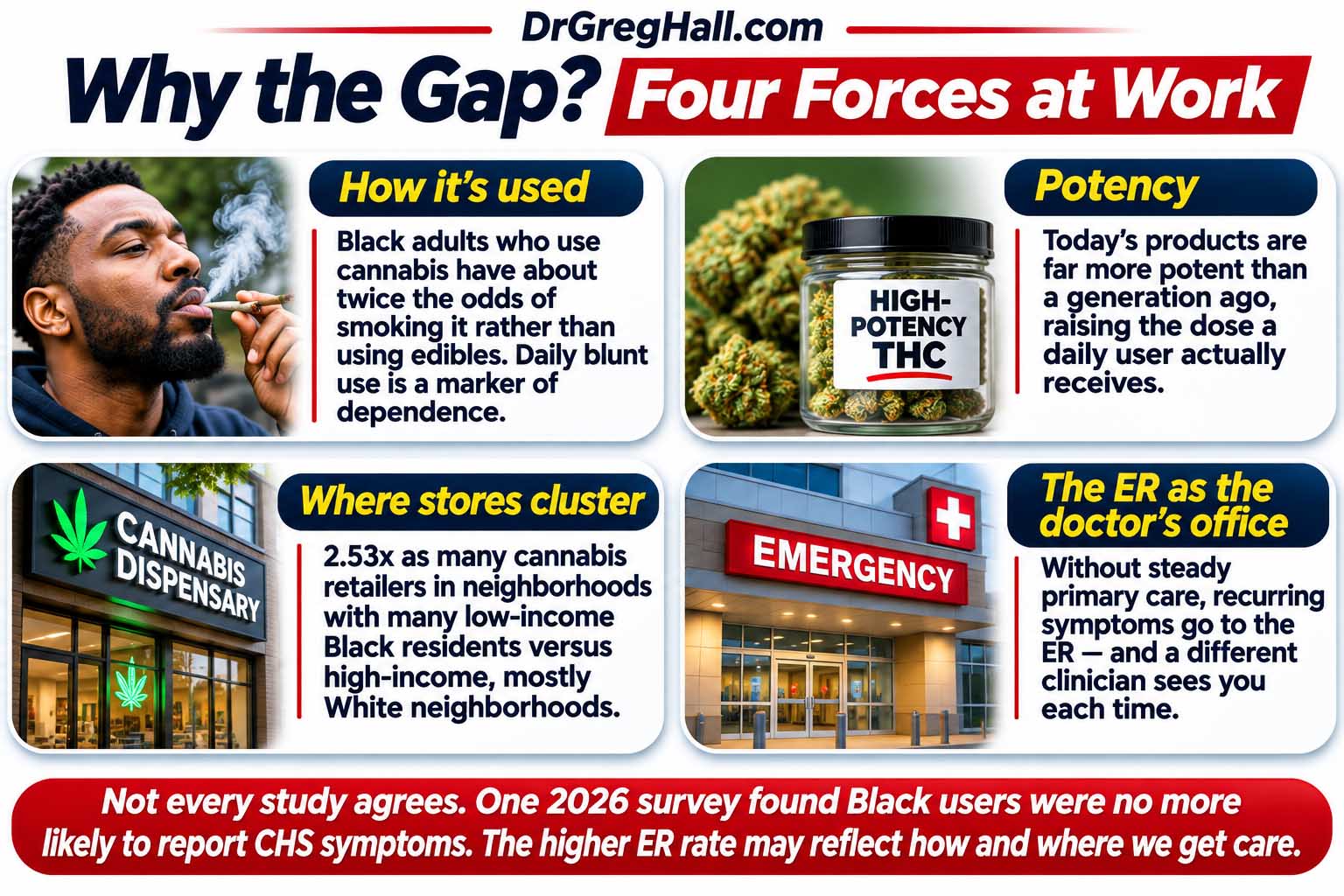
Not every survey agrees — and the two large 2026 national surveys do not even agree with each other. One, of more than 10,000 cannabis users, found about 6% reported past-year CHS, with higher rates among people who were younger, male, Hispanic, or of two or more races. Black users were not among the groups at elevated risk. The other, a national survey of 7,034 adults, found close to the opposite: those reporting CHS symptoms were more likely to be younger, female, non-White, lower income and less educated. One found men at higher risk; the other, women.
When two good national surveys point in different directions, the honest answer is that we do not yet know. The higher ER rate among Black patients may reflect how and where we get care as much as how often CHS actually occurs. Either way, the burden is real, and it is landing on us.
Bias can cut both ways. Some clinicians are slow to recognize CHS and order test after test. Others are too quick. An emergency physician writing in STAT warned that vomiting is sometimes blamed on cannabis without a proper workup, and serious conditions get missed. For Black patients, who already face doubts about their pain, a reflexive “it’s just the weed” can be dangerous.
A precision medicine view
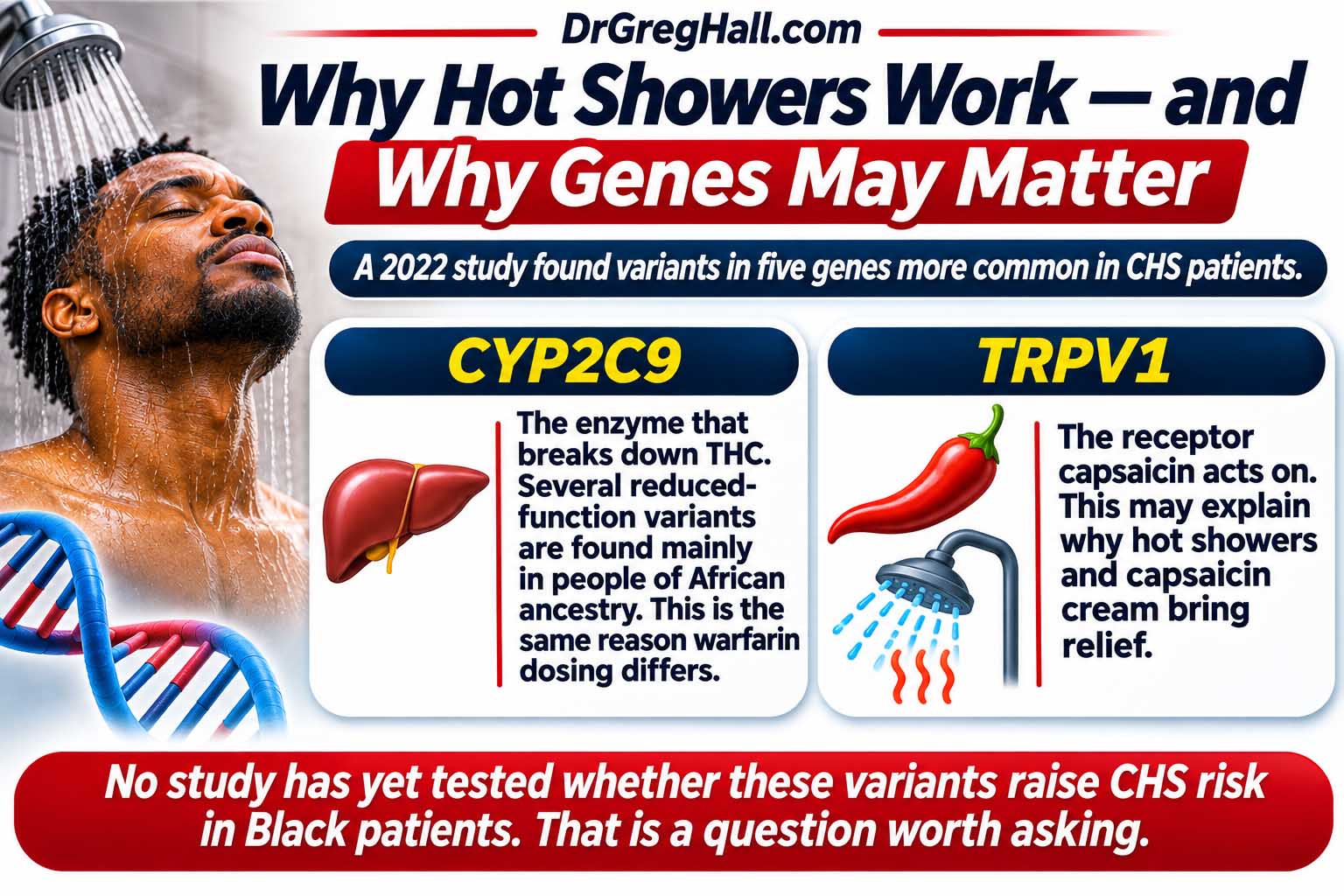
Why do some heavy users get CHS while others never do? Genes may play a part, though the evidence is thin. A small 2022 study compared 28 CHS patients with 12 cannabis users who had no symptoms. It found variants in five genes more common in the CHS group, including CYP2C9, the liver enzyme that breaks down THC, and TRPV1, the receptor that capsaicin acts on. That second finding may help explain why hot showers and capsaicin cream bring relief.
Two things to keep in mind about that study. Twelve controls is very small. And it was funded by a cannabis genetic-testing company whose chief executive and medical director are listed as co-authors, and whose team has filed a patent application on the test battery. That does not make the findings wrong. It does mean they need independent replication before anyone acts on them.
Here is where I want to be careful, because this is exactly the kind of leap that gives precision medicine a bad name.
Several reduced-function CYP2C9 variants — known as *5, *6, *8 and *11 — occur almost exclusively in people of African ancestry. Roughly 20% of African Americans carry one, and 45% to 50% carry one of those or a related variant, compared with the *2 and *3 variants that predominate in people of European ancestry. That is precisely why warfarin dosing differs, and why dosing guidelines tell clinicians to test for those alleles in patients of African ancestry.
But the CYP2C9 variant the 2022 CHS study actually found was a different one — an intronic variant with no established effect on how the enzyme works, not one of the *5, *6, *8 or *11 group. So the link to African ancestry is a question, not a finding. No study has yet tested whether any CYP2C9 variant raises CHS risk in Black patients, and the 2022 study did not report participants’ ancestry at all.
It is still a question worth asking, and it is the kind of question that gets skipped when researchers avoid looking at ancestry. It is also worth noting that these so-called African-specific alleles turn up in people who do not know they have African ancestry — which is the best argument I know for testing the individual rather than assuming from race.
Two other ancestry-related points belong in this conversation:
- Kidney risk. CHS causes dehydration and acute kidney injury. Black Americans who carry two APOL1 risk variants already have kidneys that are more vulnerable. In my judgment, repeated episodes of severe dehydration are an added threat to kidneys that may already be at risk, and that deserves attention.
- Sickle cell disease. Vomiting and severe abdominal pain in a patient with sickle cell disease should never be written off as CHS without ruling out a sickle cell crisis and other serious causes.
I write about this kind of question in two places, for two audiences. Better Black Health is for patients and families. Precision Medicine for African Americans (Springer Nature, 2nd ed., 2025) is the clinical reference.
What to do about it
If you use cannabis regularly:
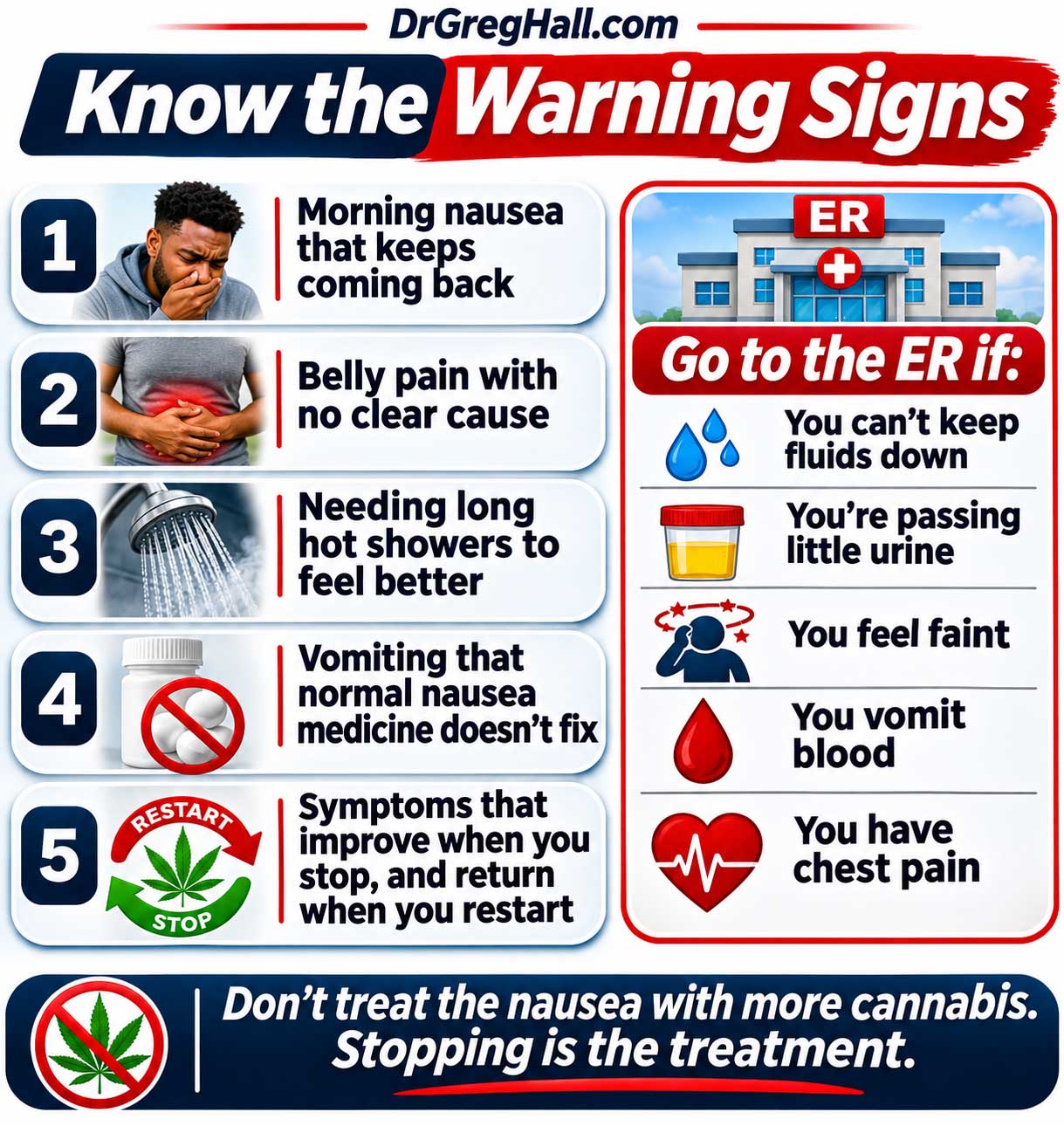
- Know the warning signs: morning nausea, belly pain, and needing hot showers to feel better.
- Don’t treat the nausea with more cannabis. If symptoms start, stopping is the treatment.
- Expect recovery to take time. It can take weeks or months off cannabis for symptoms to fully clear.
- Be honest with your doctor about how much and what kind you use. It can save you a stack of unnecessary tests.
Go to the emergency room if you cannot keep fluids down, you are passing little urine, you feel faint, you vomit blood, or you have chest pain.
For families: if a loved one keeps going to the ER for vomiting, ask the question. Many people have never heard of CHS and don’t make the connection on their own.
For clinicians: the CDC now recommends asking every patient with nausea, vomiting and abdominal pain about cannabis use, including frequency, duration, product type and route. Ask without judgment. Then complete the workup. A Black patient deserves both: the question asked, and the serious causes ruled out.
References
- Vivolo-Kantor AM, Liu S, Tanz LJ, Mattson CL, Schier J. Trends in emergency department visits involving cannabis hyperemesis syndrome identified using a new diagnosis code — United States, January 2023–May 2026. MMWR. 2026;75(30).
- Swartz JA, Franceschini D. Cannabinoid hyperemesis syndrome, 2016 to 2022. JAMA Netw Open. 2025;8(11):e2545310.
- Miki A, et al. Cannabinoid hyperemesis syndrome in Massachusetts emergency departments, 2012–2021. Am J Gastroenterol. December 2025. HealthDay summary.
- Glodosky NC, Okey SA, Watson TD, Hammond D. Cannabinoid hyperemesis syndrome prevalence and risk factors in the U.S. Int J Drug Policy. 2026.
- Black D, Rasouliyan L, Althoff AG. Retrospective analysis of cannabis hyperemesis syndrome using US electronic medical records. ISPOR 2025.
- Russo EB, Spooner C, May L, Leslie R, Whiteley VL. Cannabinoid hyperemesis syndrome survey and genomic investigation. Cannabis Cannabinoid Res. 2022;7(3):336–344.
- Russo EB, Whiteley VL. Cannabinoid hyperemesis syndrome: genetic susceptibility to toxic exposure. Front Toxicol. 2024;6:1465728.
- Kephart LL, et al. Cannabis retailer concentration and neighborhood disadvantage across 18 US states. Am J Prev Med. 2025. Press release.
- Disparities in use modalities among adults who currently use cannabis, 2022–2023. J Cannabis Res. 2025;7(1):26.
- Racial disparities in patterns and modes of current and daily marijuana use among adults living with children. J Racial Ethn Health Disparities. 2025;12(3):1787–1796.
- Mantey DS, Onyinye ON, Montgomery L. Prevalence and correlates of daily blunt use among U.S. African American, Hispanic and White adults, 2014–2018.
- Lapoint J, et al. Cannabinoid hyperemesis syndrome: public health implications and a novel model treatment guideline. West J Emerg Med. 2018;19(2):380–386.
- Cannabis hyperemesis syndrome and ER overdiagnosis. STAT First Opinion, July 8, 2025.
- More than a hot shower: treatment for cannabinoid hyperemesis syndrome. emDocs.
- Ilgen MA, Price AM, Goldman P, Whittington BJ, Hicks BM. Prevalence and correlates of symptoms of cannabinoid hyperemesis syndrome in the United States. 2026. medrxiv.org
- Johnson JA, Caudle KE, Gong L, et al. Clinical Pharmacogenetics Implementation Consortium (CPIC) guideline for pharmacogenetics-guided warfarin dosing: 2017 update. Clin Pharmacol Ther. 2017;102(3):397-404. cpicpgx.org