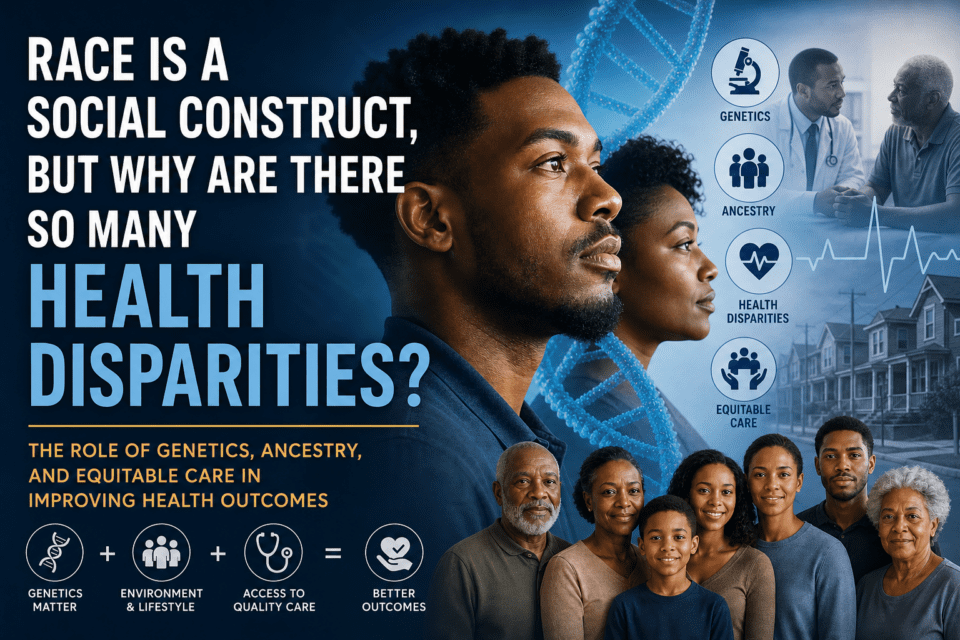

For years, we’ve heard a well-intentioned statement repeated in medicine and academia: “Race is a social construct.”
At a high level, that statement is true. The genetic differences between humans are small—any two people’s DNA is about 99.6% identical.[1] But somewhere along the way, this truth has been oversimplified into a dangerous clinical assumption: that race—and by extension, ancestry—does not matter in medical care.
That assumption is not only inaccurate—it is harmful.
The Oversimplification Problem
In 1972, geneticist Richard Lewontin demonstrated that about 85% of human genetic variation exists within populations rather than between them.[2] This finding has been widely interpreted to mean that race has no biological relevance.
But that’s not the full story.
Even small genetic differences, when clustered within populations, can have outsized clinical effects—particularly in areas like pharmacogenomics, cardiovascular risk, and disease susceptibility. In fact, research shows that even with minimal between-group variation, there can still be hundreds of excess adverse drug reactions per 1,000 patients depending on genetic distribution.
In other words:
Small differences at the genetic level can produce large differences at the clinical level.
Ignoring that reality does not eliminate disparities—it worsens them.
Race vs. Ancestry: What Actually Matters?
Race, as we use it in society, is indeed a social construct. But ancestry is biological, and it matters.
Modern medicine is increasingly shifting toward precision medicine—an approach that considers genetics, environment, and lifestyle together. As defined by the NIH, this model recognizes that individuals have unique molecular and physiological characteristics that require tailored interventions.[3]
For African Americans, this distinction is critical.
Many of the genetic traits seen today are not “defects”—they are adaptations developed over centuries:
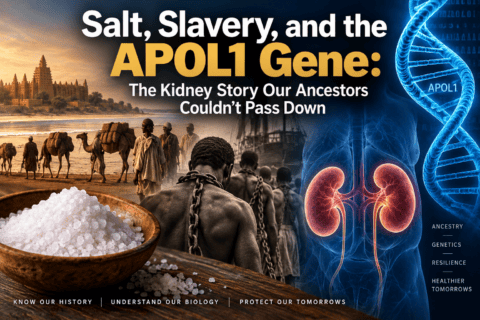
- Salt sensitivity linked to ancestral low-sodium environments (read more about salt sensitivity)
- Sickle cell trait as protection against malaria
- Differences in vitamin D metabolism due to equatorial sun exposure (read more about vitamin D)
- Variations in drug metabolism and cardiovascular response
These adaptations once improved survival. In today’s environment, they often contribute to higher rates of hypertension, kidney disease, and cardiovascular complications.
The Data Are Clear: Disparities Are Real
Health disparities are not theoretical—they are measurable and persistent:
- African Americans have higher rates of hypertension, stroke, and heart failure
- Cancer mortality is higher across multiple major cancers
- There are higher rates of adverse surgical outcomes—even after controlling for comorbidities
- African Americans are less likely to receive advanced treatments or referrals
These differences are not explained by a single factor. They are the result of a complex interaction between genetics, environment, and healthcare delivery.
The Danger of “Colorblind Medicine”
There is a growing movement to remove race from medical decision-making entirely. While well-intentioned, this approach risks creating a form of clinical blindness.
If we ignore population-level differences:
- We may miss higher-risk conditions
- We may choose less effective medications
- We may under-screen for aggressive disease patterns
- We may misinterpret lab values or symptoms
As I explain in my book Precision Medicine for African Americans (Springer Nature, 2nd ed., 2025), eliminating race and ethnicity from clinical consideration may actually exacerbate health disparities rather than reduce them.
Precision Medicine in Action: Real Examples
This is not abstract. Here is what the difference between crude race labels and true precision medicine looks like in everyday care:
- Kidney tests. For decades, the standard formula for kidney function automatically adjusted results upward for Black patients — a crude race label that could delay referrals and transplant listing. In 2021, kidney specialists recommended removing it.[4] The precision replacement is not ignoring ancestry; it is testing for what actually matters, such as the APOL1 gene.
- Pulse oximeters. The fingertip oxygen monitors used in every hospital can overestimate oxygen levels in people with darker skin. One major study found dangerously low oxygen was missed nearly three times as often in Black patients as in white patients.[5] Here, ignoring difference — not acknowledging it — caused the harm.
- Heart risk. African Americans have the highest average levels of lipoprotein(a), an inherited heart risk that a standard cholesterol panel does not measure.
- Blood clots. The genetic clotting tests most doctors order were built around variants that are rare in Black patients, so a normal result can miss real clot risk.
- Diabetes testing. The A1c test can read lower than a person’s true blood sugar in people with sickle cell trait, which can delay a diabetes diagnosis.[6] (More on A1c accuracy.)
Each example follows the same rule: use ancestry and population data to ask better questions — then test the individual in front of you.
It’s Not Just Genetics
To be clear, genetics alone does not explain disparities.
Other major contributors include:
- Social determinants of health
- Environmental exposures
- Access to care
- Implicit bias in clinical decision-making
- Historical mistrust of the healthcare system
In fact, many disparities are driven by how care is delivered, not just biology.
For example:
- African Americans are less likely to receive advanced therapies
- They experience longer delays in treatment
- They are more often treated in under-resourced hospitals
Even when controlling for income and insurance, disparities persist.[7]
A More Honest Approach: Nuance Over Ideology
The solution is not to abandon the concept of race.
The solution is to use it correctly.
We need a more nuanced framework:
- Recognize that race is socially defined
- Understand that ancestry has biological relevance
- Use population data as a clinical guide—not a stereotype
- Apply insights thoughtfully to the individual patient
This is not about labeling patients—it’s about improving outcomes.
What Clinicians Should Do
To move forward effectively, clinicians must:
- Acknowledge differences without assigning value or bias
- Understand population-level risks and incorporate them into care
- Avoid one-size-fits-all medicine
- Recognize and correct implicit biases
- Adopt precision medicine principles
Most importantly:
Consider differences—don’t ignore them.
The Bottom Line
Yes, race is a social construct. But health disparities are not. They are real, measurable, and often predictable. Ignoring race in medicine does not create equity—it creates blind spots. And in healthcare, blind spots cost lives.
The future is not “race-based medicine” or “race-blind medicine.”
The future is precision medicine—where we integrate genetics, environment, culture, and lived experience to deliver the best possible care.
That is how we reduce disparities.
That is how we improve outcomes.
And that is how we move medicine forward.
Watch: Why “The Same” Medical Care Fails Black Patients
References
- National Human Genome Research Institute. Human genomic variation (fact sheet). genome.gov/about-genomics/educational-resources/fact-sheets/…
- Lewontin RC. The apportionment of human diversity. Evolutionary Biology. 1972;6:381-398. doi.org/10.1007/978-1-4684-9063-3_14
- MedlinePlus Genetics (National Library of Medicine, NIH). What is precision medicine? medlineplus.gov/genetics/understanding/precisionmedicine/def…
- Delgado C, Baweja M, Crews DC, et al. A unifying approach for GFR estimation: recommendations of the NKF-ASN Task Force on Reassessing the Inclusion of Race in Diagnosing Kidney Disease. J Am Soc Nephrol. 2021;32(12):2994-3015. doi.org/10.1681/ASN.2021070988
- Sjoding MW, Dickson RP, Iwashyna TJ, Gay SE, Valley TS. Racial bias in pulse oximetry measurement. N Engl J Med. 2020;383(25):2477-2478. doi.org/10.1056/NEJMc2029240
- Lacy ME, Wellenius GA, Sumner AE, et al. Association of sickle cell trait with hemoglobin A1c in African Americans. JAMA. 2017;317(5):507-515. pubmed.ncbi.nlm.nih.gov/28170479/
- Institute of Medicine. Unequal Treatment: Confronting Racial and Ethnic Disparities in Health Care. Washington, DC: National Academies Press; 2003. nap.nationalacademies.org/catalog/12875/unequal-treatment-co…