

3 out of 4 of us have lactose intolerance
An estimated three out of four African Americans are lactose intolerant. Lactose intolerance means that when you drink milk or eat yogurt, cheese, or other dairy foods in large amounts, your digestive system has trouble breaking them down. Most people feel bloated and later have loose, gassy stools (sorry . . . but these are the facts).
If you’re not near a toilet (of your choice), this can be an embarrassing problem. Lactose is a natural sugar in dairy foods. When your body can’t digest it, the gut simply flushes it through. For most African Americans with lactose intolerance, the result is avoiding milk and milk products altogether.
“Milk is bad for us?”
Drinking far less milk and eating fewer dairy foods may carry a health cost for African Americans. According to the Dietary Guidelines for Americans, “moderate evidence shows that the intake of milk and milk products is associated with a reduced risk of cardiovascular disease, type 2 diabetes, and lower blood pressure in adults.” In that article, “Nutrition and Health Disparities: The Role of Dairy in Improving Minority Health Outcomes,” dietitian Constance Brown-Riggs recommends that African Americans have three to four servings of low-fat dairy a day.
If one serving of dairy causes stomach upset and loose stools . . . what will three servings do? That’s the question many African Americans ask themselves, and the answer has been clear. African Americans drink significantly less milk and eat much less cheese and yogurt than the rest of the American population.
Eating less dairy means getting fewer of the essential nutrients found in milk and cheese. Studies show that African Americans get less calcium, vitamin D, and potassium than white and Hispanic Americans. And it is well known in medical circles that African Americans have significantly lower vitamin D levels in their blood.
A genetic link for lactose intolerance

For African Americans, avoiding milk is not simply a choice. Lactose intolerance is largely genetic, and the share of people who are lactose intolerant is tied to where their ancestors came from. Put simply, regions where dairy herds could be raised safely and efficiently produced people who could digest lactose. Cornell University researchers found that harsher climates in parts of Africa and Asia limited the availability of milk and produced populations with much more lactose intolerance. They found a wide range, from as low as 2 percent of people of Danish descent to nearly 100 percent of people of Zambian descent.
Their survey “found that lactose intolerance decreases with increasing latitude and increases with rising temperature.”

Several adjustments are needed when we talk about advice centered on African Americans. The U.S. Department of Agriculture’s healthy eating recommendations rely heavily on dairy. Yet most African Americans are lactose intolerant and can’t easily meet that goal.
Calcium is also not one-size-fits-all. A 2022 study of nearly 29,000 men, including more than 6,000 Black men, found that men who ate the most dairy had a 27% higher risk of prostate cancer than men who ate the least, with a similar pattern in Black men. Calcium from non-dairy foods was not linked to higher risk. Because Black men have the highest prostate cancer risk, I advise them to watch their calcium intake. Read more in the prostate cancer section of the “Better Black Health” book.
The precision medicine connection
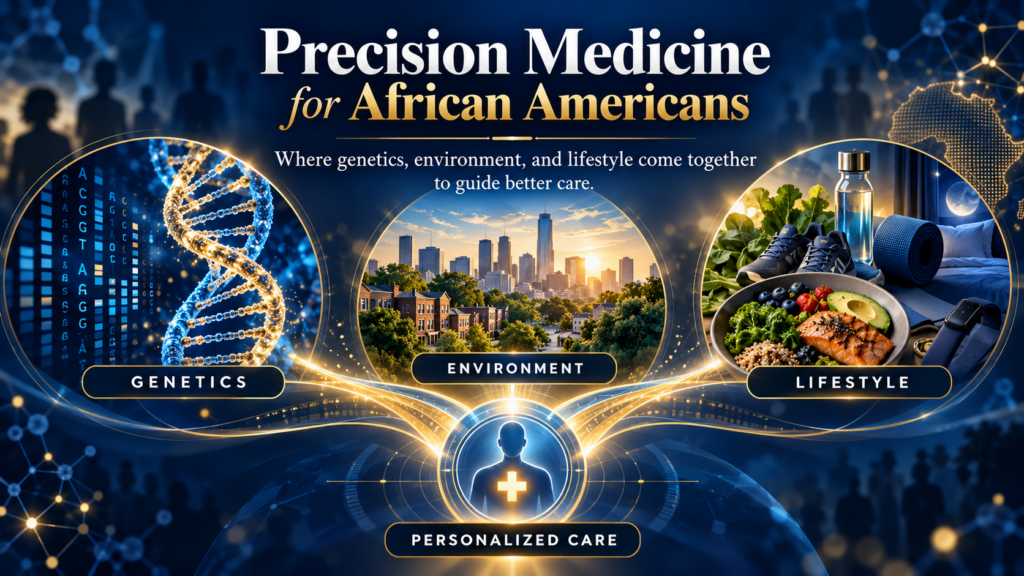
Lactose intolerance is one of the clearest examples of ancestry shaping health. Here is how precision medicine applies.
1. It is written in your lactase gene
Every baby makes lactase, the enzyme that digests milk sugar. In most of the world, the gene for lactase (LCT) turns down after childhood. Small DNA changes near that gene keep it switched on for life. The most common one arose in Europe. Researchers found different variants arose separately among cattle-herding peoples of East Africa. Most African Americans trace their ancestry to West and Central Africa, where these variants are rare, which helps explain why about 3 in 4 are lactose intolerant. Consumer DNA tests often report these variants.
2. You may tolerate more than you think
A review for the National Institutes of Health found that most people with lactose intolerance can handle 12 to 15 grams of lactose, about one cup of milk, especially with a meal. Aged cheeses like cheddar and Swiss have very little lactose. Lactose-free milk, lactase pills, and yogurt are other options. You don’t have to give up dairy completely to avoid symptoms.
3. Get calcium and vitamin D in other ways
Good non-dairy sources of calcium include collard and turnip greens, kale, calcium-fortified orange juice and plant milks, tofu made with calcium, and canned salmon or sardines with the bones. Vitamin D is harder to get from food. I recommend 2,000 IU of vitamin D a day for most African Americans.
4. Know the safety limits
Not every stomach problem after dairy is lactose intolerance. Symptoms that start in adulthood, weight loss, blood in the stool, or diarrhea that wakes you at night need a doctor’s evaluation for conditions like celiac disease or inflammatory bowel disease. Don’t go over the upper limit for calcium (2,000 to 2,500 mg a day for adults, depending on age) or 4,000 IU of vitamin D a day unless your doctor prescribes it.
Dr. Hall’s podcast, Better Black Health, covers many issues related to African American health . . . take a listen.
The impact of leaving Africa doesn’t end with lactose and vitamin D. Read Displaced: Why African Americans Need Their Own Multivitamin.