


Ask “who was the first doctor in history?” and you’ll find a surprising amount of confusion online — including, absurdly, articles that mix him up with a British science-fiction character. The real answer is far more interesting than fiction.
The first doctor in history — the first physician anywhere in the world known to us by name — was an African man who lived roughly 4,600 years ago: Imhotep, physician, architect, and chief advisor to an Egyptian pharaoh. Centuries before Hippocrates, the Greek physician most Westerners are taught to call the “father of medicine,” Imhotep was already practicing, teaching, and being remembered for it.
Who Was Imhotep?
Imhotep lived during Egypt’s Third Dynasty, in the 27th century BCE, serving under Pharaoh Djoser. He rose from commoner origins to become one of the most powerful officials in Egypt — chancellor to the king, high priest of Heliopolis, and chief architect of the royal court.
We know he was real, not legend, because his name appears carved into a statue base at Djoser’s pyramid complex at Saqqara — a rare honor for anyone who wasn’t royalty. The inscription lists his titles, including “chief of the sculptors” and “chief of the seers.”
Why Imhotep Is Considered the First Doctor in History
Egyptologists and medical historians widely credit Imhotep as the first physician known by name in recorded history — not the first person to ever practice healing, but the first whose identity survived, attached to medical reputation, across thousands of years.
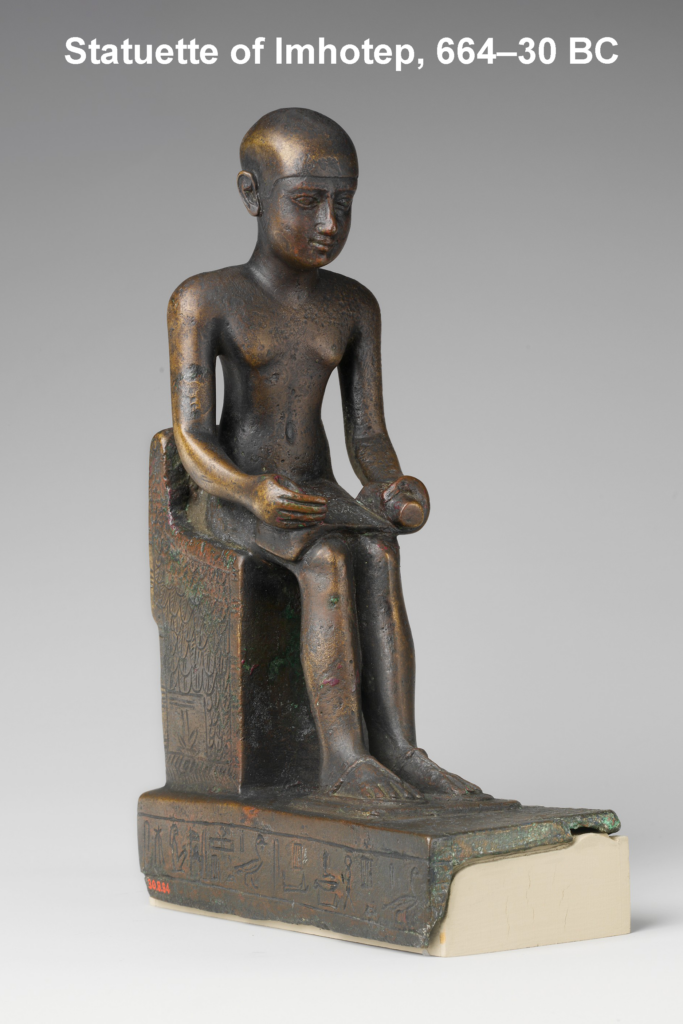
What set him apart wasn’t just that he treated the sick. Ancient Egyptian healing at the time leaned heavily on magic and religious ritual. Imhotep’s approach — reflected in the medical tradition later associated with his name — was different: observation, diagnosis, and treatment, grounded in what could be seen and tested rather than only invoked through prayer. That shift, however incomplete by modern standards, is why historians treat him as a genuine milestone in the history of medicine rather than just an ancient healer among many.
The physician and medical historian Sir William Osler — one of the founding figures of modern American medicine — called Imhotep “the first figure of a physician to stand out clearly from the mists of antiquity.” That’s a remarkable statement from one of the most respected voices in the field: the discipline of medicine, as a distinct practice separate from pure religion, has a name attached to its earliest known chapter — and it’s African.
The Architect Who Was Also a Doctor
Imhotep’s medical reputation didn’t stand alone. He was also, by most accounts, the first architect known by name in world history — designer of the Step Pyramid at Saqqara, the first large-scale cut-stone building ever constructed. It became the tomb of Pharaoh Djoser and the template for every pyramid that followed.
Think about what that combination represents: the same mind credited with founding rational medicine was also solving some of the most advanced engineering problems of the ancient world. Imhotep wasn’t a specialist in the modern sense — he was a polymath in an era when medicine, architecture, astronomy, and priesthood weren’t yet separate fields.
From Physician to God
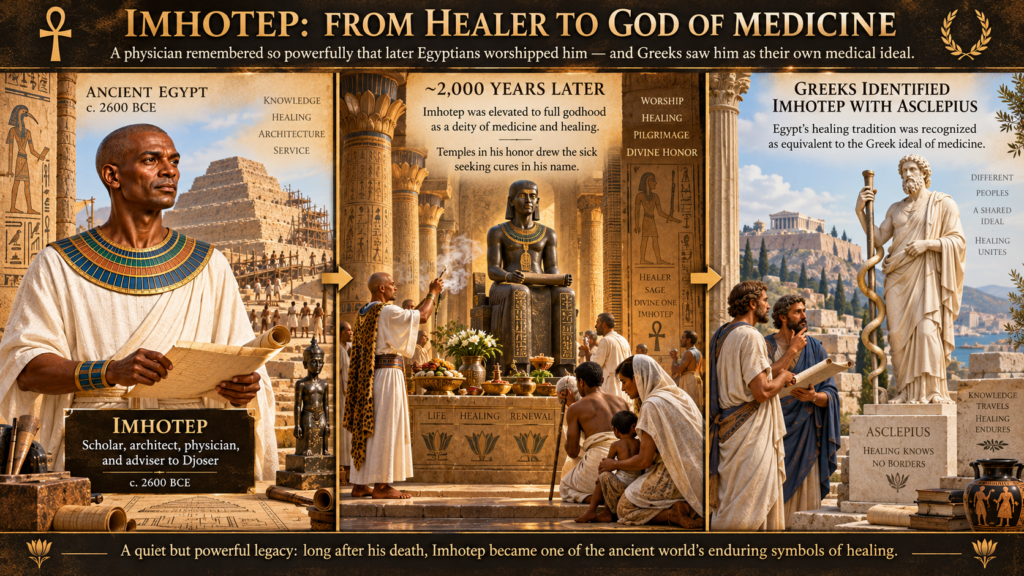
Perhaps the most extraordinary part of Imhotep’s story is what happened after his death. Roughly 2,000 years later, the Egyptians elevated Imhotep to full godhood — worshipped as the deity of medicine and healing, with temples built in his honor. Sick people traveled to those temples seeking cures in his name.
When the Greeks encountered Egyptian religion centuries later, they recognized the parallel immediately and identified Imhotep with their own god of medicine, Asclepius. It’s a quiet but telling detail: the civilization that gave the Western world Hippocrates also looked at Egypt’s healing tradition and saw something equivalent to their own highest medical ideal.
No other physician in recorded history — ancient or modern — has been honored quite like that.
What Historians Actually Know vs. What’s Legend
A responsible account of Imhotep should be honest about where the historical record and popular tradition diverge — something too many articles online skip entirely.
- What’s well-documented: Imhotep was a real, high-ranking official under Djoser; he’s credited as chief architect of the Step Pyramid; centuries after his death, he was worshipped as a god of medicine.
- What’s traditional attribution, not contemporary record: No surviving document from Imhotep’s own lifetime explicitly calls him a “practicing physician” in those words — that association comes from later Egyptian tradition and the medical reputation that grew around his name over centuries. Similarly, the famous Edwin Smith Papyrus — the oldest known surgical text, with 48 clinical case studies structured around observation, diagnosis, treatment, and prognosis — is sometimes popularly credited to Imhotep. Historians can’t confirm he wrote it; the surviving copy dates to roughly 1600 BCE, centuries after he lived, though many scholars believe its content draws on a much older tradition Imhotep may have helped originate.
That distinction doesn’t diminish Imhotep’s place in history — if anything, it makes his legend more remarkable. A reputation that grows stronger over 2,000 years, eventually reaching godhood, isn’t built on nothing.
Why This History Matters Today
The story of medicine’s origins is too often told starting in ancient Greece, as though nothing of consequence happened before Hippocrates. That’s not just incomplete — it’s inaccurate. The first named doctor in human history practiced on African soil, using methods that anticipated the clinical method physicians still use today: observe, diagnose, treat, predict.

That throughline — from Imhotep’s Egypt to modern clinical practice — is part of a much longer story about the depth of African contribution to medicine and science, one I explore further both in my work on precision medicine and in Better Black Health: A Comprehensive Guide in the Age of Precision Medicine.
Frequently Asked Questions
Who was the first doctor in the world?
Imhotep, an Egyptian physician and architect who served Pharaoh Djoser around 2650 BCE, is widely regarded as the first physician known by name in recorded history.
Was Imhotep real or a myth?
Imhotep was a real historical figure — his name is inscribed on a statue at Djoser’s pyramid complex. He was deified as a god of medicine roughly 2,000 years after his death, which is where his story shifts from documented history into religious legend.
Did Imhotep come before Hippocrates?
Yes — by nearly 2,000 years. Imhotep lived around 2650 BCE; Hippocrates lived around 460–370 BCE.
Did Imhotep write the Edwin Smith Papyrus?
It’s traditionally associated with him, but not confirmed. The surviving copy dates centuries after his lifetime, and historians can’t verify direct authorship.