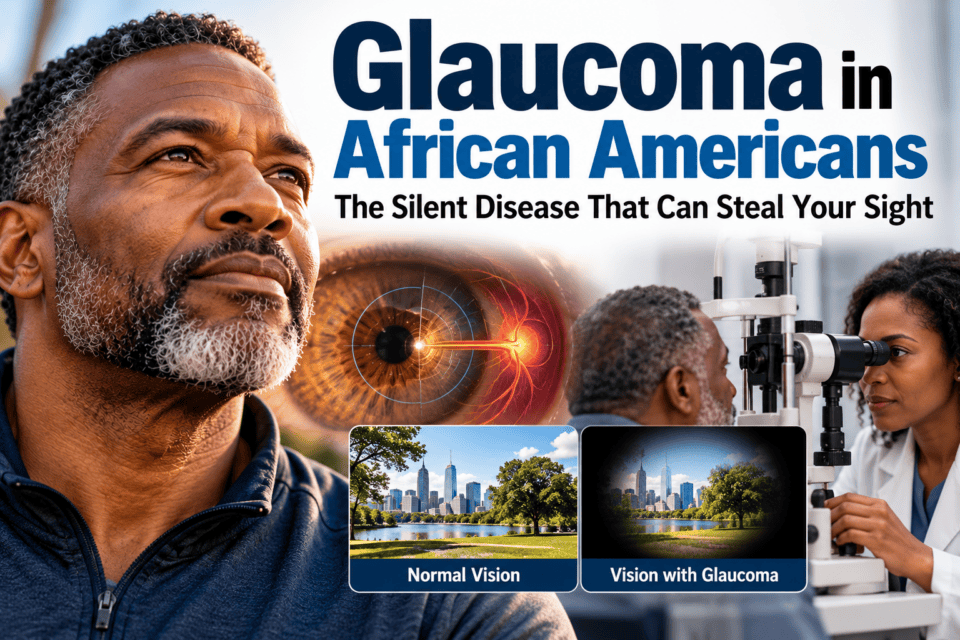

Glaucoma does not hurt. It does not blur your reading vision or make your eyes red. Most people who have it feel completely fine, until the day they notice they cannot see the car coming up beside them. By then, the damage is permanent.
For Black Americans, this silent disease is especially dangerous. According to the Glaucoma Research Foundation, people of African descent are about five times more likely to develop glaucoma and six times more likely to go blind from it, and the disease tends to appear about 10 years earlier. The National Eye Institute reports that Black Americans have some of the highest rates of vision loss and blindness from eye disease in the country, and that those rates are rising.
The good news: glaucoma blindness is largely preventable. The disease can be found with a simple exam years before you would notice anything, and treatment works. The problem is that too many of us never get the exam.
What glaucoma is, and why you will not feel it
Glaucoma is a group of diseases that damage the optic nerve, the cable that carries images from the eye to the brain. The most common form in Black Americans is primary open-angle glaucoma. It is usually linked to pressure building up inside the eye, although damage can occur even at normal pressure.
The damage starts at the edges of your vision. The National Eye Institute notes that the first loss is usually side vision, especially the part closest to your nose. Your brain fills in the gaps, and your other eye covers for the weak one, so you do not notice. Central vision, the part you use to read and recognize faces, is often the last to go.
That is why glaucoma is called the silent thief of sight. Vision lost to glaucoma cannot be restored. The only way to protect it is to find the disease before you notice anything wrong.
Why Black Americans face higher risk
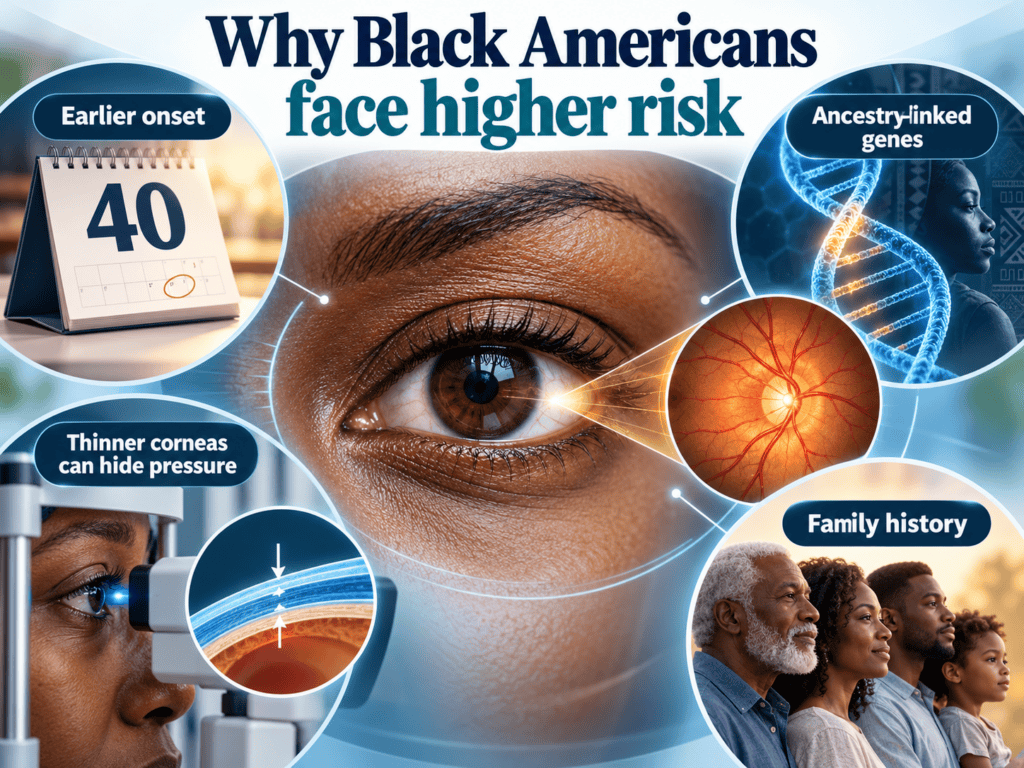
It starts earlier and moves faster. Glaucoma tends to appear about a decade earlier in people of African descent. That is why the National Eye Institute singles out African Americans over age 40 as a high-risk group, rather than waiting until 60 as it does for the general population.
Genes linked to African ancestry. A large international study of people of African ancestry, published in JAMA in 2019, found a variant near the APBB2 gene that raises glaucoma risk. The risk version of this variant was common only in people of African ancestry; it was found in fewer than 1 in 1,000 people of European or Asian ancestry. Earlier genetic studies, built mostly on European populations, would never have found it.
Thinner corneas can hide high pressure. The cornea is the clear front window of the eye. The standard eye pressure test measures through it, and a thinner cornea can make pressure read lower than it really is. In the landmark Ocular Hypertension Treatment Study, African American participants tended to have thinner corneas and larger optic nerve cupping, placing more of them in the high-risk group. This is a good example of precision medicine: a “normal” pressure reading means something different depending on the eye being measured. Ask whether your corneal thickness has been checked.
Family history. Having a parent or sibling with glaucoma raises your risk substantially. Ask your relatives. Many people with glaucoma have never told their families, and many do not know they have it.
The second silent threat: diabetic retinopathy
Glaucoma is not the only eye disease that steals vision quietly. Diabetic retinopathy, damage to the blood vessels in the back of the eye caused by diabetes, is the other major cause of blindness in Black Americans. The National Eye Institute estimates that more than 825,000 Black Americans have diabetic retinopathy, a number expected to pass 1 million by 2030.
Like glaucoma, it often has no symptoms until it is advanced. High blood pressure makes it worse. Because Black Americans have higher rates of both diabetes and hypertension, the risks stack. And having diabetes also raises your risk of glaucoma.
If you have diabetes, a dilated eye exam every year is not optional. It is part of your diabetes care, the same as your A1c and your kidney tests. The same exam checks for both diseases at once.
The exam that catches it
The test that finds glaucoma is a comprehensive dilated eye exam. The National Eye Institute describes it as simple and painless: drops widen your pupils so the eye doctor can see the optic nerve directly. The exam usually also includes a pressure check and may include a side-vision test and a scan of the optic nerve.
This is not the same as a vision screening at the drugstore, the DMV or a glasses fitting. Reading the eye chart tells you nothing about glaucoma, because glaucoma spares central vision until late. You need an ophthalmologist or optometrist to look at the optic nerve.
How often? The National Eye Institute says people at higher risk should get a comprehensive dilated eye exam every 1 to 2 years. For Black adults, that means starting at age 40. Your eye doctor may recommend yearly exams if you have diabetes, a family history, thin corneas or borderline findings.
Medicare pays for it. Medicare Part B covers a glaucoma test once every 12 months for African Americans age 50 and older, as well as for anyone with diabetes or a family history of glaucoma. You pay 20% of the Medicare-approved amount after the Part B deductible. Few people know this benefit exists.
Treatment works, if you stay with it
Glaucoma cannot be cured, but it can usually be controlled. The goal is to lower eye pressure enough to stop further damage. The National Eye Institute lists three main options:
- Prescription eye drops, the most common treatment
- Laser treatment in the doctor’s office to help fluid drain from the eye
- Surgery when drops and laser are not enough
The evidence that treatment works is strong, and it holds for Black patients. In the Ocular Hypertension Treatment Study, lowering eye pressure by about 20% with medication cut the risk of developing glaucoma by 50%, and African American participants had similar pressure reductions and similar benefit.
The hardest part is staying on treatment. Drops must be used every day, often for life, and they treat a disease you cannot feel. Missed doses, costly prescriptions and side effects lead many people to stop. If drops are a struggle, tell your eye doctor. Laser treatment can reduce or replace drops for many patients.
The precision medicine connection
Glaucoma is a clear case where ancestry should change how we test and treat. Here is how precision medicine applies to Black Americans.
1. Your genes raise the stakes
The APBB2 risk variant found in people of African ancestry is one of several genetic differences now being studied. Genetic testing for glaucoma is not yet routine, so your family history is still the best genetic test you have. A parent or sibling with glaucoma, combined with African ancestry, is a reason for earlier and more frequent exams.
2. Your pressure reading needs your corneal thickness
In the Ocular Hypertension Treatment Study, African American participants had corneas that averaged 23 microns thinner than those of white participants (556 vs. 579 microns). A thin cornea can make eye pressure read falsely low, so a “normal” number may not be normal for you. Ask for pachymetry, a quick, painless measurement of corneal thickness, at least once.
3. Your blood pressure affects your optic nerve
The optic nerve needs steady blood flow. In the Barbados Eye Studies, which followed more than 3,200 adults of African descent for nine years, low ocular perfusion pressure (blood pressure that is too low relative to eye pressure) more than doubled the risk of glaucoma. Black Americans are more likely to take blood pressure medicines, so blood pressure that drops too low, especially overnight, may matter. Don’t stop any medicine, but make sure your primary care doctor and eye doctor know about each other’s treatment.
4. Know your medicines and their limits
Prostaglandin drops such as latanoprost, travoprost and bimatoprost are usually the first choice, and a study comparing them by race found they lower pressure well in Black patients. They can darken the eyelid skin and lengthen lashes. Timolol and other beta-blocker drops are absorbed into the bloodstream and can slow the heart rate or trigger breathing problems, which matters because asthma is more common in Black Americans. Tell your eye doctor if you have asthma, COPD or a slow heart rate. Pressing gently on the inner corner of your eye for a minute after each drop keeps more of the medicine in the eye and less in your body.
What to do now
- If you are Black and 40 or older, schedule a comprehensive dilated eye exam. Not a vision screening; a dilated exam with an ophthalmologist or optometrist.
- Repeat it every 1 to 2 years, or every year if you have diabetes, a family history of glaucoma or borderline results.
- Ask your family. Find out whether parents, brothers or sisters have glaucoma, and tell your eye doctor.
- Ask about your corneal thickness and what your eye pressure means for your eyes specifically.
- If you have diabetes, get a dilated exam every year, and keep your blood sugar and blood pressure under control.
- If you are on Medicare and 50 or older, use your annual glaucoma test benefit.
- If you are diagnosed, stay on treatment. Use your drops every day, keep your follow-up visits, and speak up if cost or side effects are getting in the way.
You can be going blind and not know it. But you do not have to. A single exam can find glaucoma years before it takes your sight, and treatment can keep it from ever doing so.
Sources
- National Eye Institute. Glaucoma.
- National Eye Institute. Eye Health Among Black/African American People.
- Glaucoma Research Foundation. African Descent and Glaucoma: Unraveling the Genetics Putting a Community at Higher Risk.
- Genetics of Glaucoma in People of African Descent Consortium. Association of Genetic Variants With Primary Open-Angle Glaucoma Among Individuals With African Ancestry. JAMA. 2019;322(17).
- BrightFocus Foundation. Review of the Ocular Hypertension Treatment Study.
- Medicare.gov. Glaucoma Test Coverage.
- Brandt JD, et al. Central corneal thickness in the Ocular Hypertension Treatment Study (OHTS). Ophthalmology. 2001.
- Leske MC, et al. Risk factors for incident open-angle glaucoma: the Barbados Eye Studies. Ophthalmology. 2008.
- Prostaglandin Efficacy and Safety Study Undertaken by Race (the PRESSURE Study). J Glaucoma.