
Many of my patients have high cholesterol and are on cholesterol lowering medicines called statins like Lipitor (atorvastatin), Zocor (simvastatin), and Crestor (rosuvastatin). Occasionally they will come in saying some well-meaning friend told them that “cholesterol medicine is bad for them.” They ask me: “Is cholesterol lowering medicine bad for you?”
My answer is almost always: Absolutely NOT. But where does this notion come from? Where does it say that statins (what we call this group of medicines) are bad for you?
Statins are among the most widely prescribed medicines in America, and many more people qualify for them than take them. African Americans have higher rates of heart disease, diabetes, and circulation problems, so the odds of an African American being advised to start a statin are high.
What do statins do?
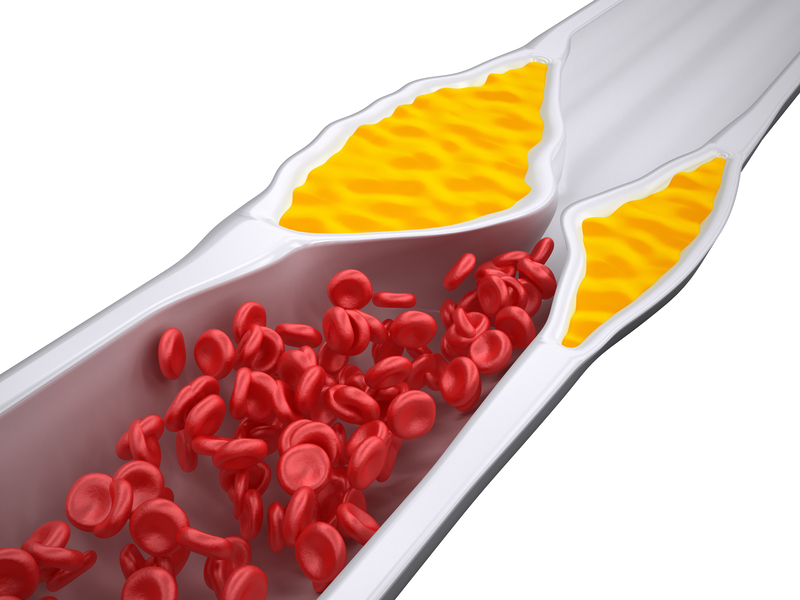
Essentially, statins lower your cholesterol (total cholesterol and bad cholesterol), and by lowering the cholesterol, the “clogging” of the arteries with cholesterol is lessened. It’s that simple.
The higher the cholesterol, the more clogging of arteries. If you clog the arteries in your brain, you get a stroke. Clog the arteries in your heart, you have a heart attack. Clog the arteries in your legs, you get poor circulation to your feet which could cause infections that could lead to amputation. By lowering the amount of cholesterol, you lower the chance of clogging . . . anywhere.
Statins do more than lower a number. They calm inflammation in the artery walls and help stabilize existing plaque so it is less likely to rupture and cause a heart attack or stroke. In studies of high-intensity statins, plaque even shrank modestly.
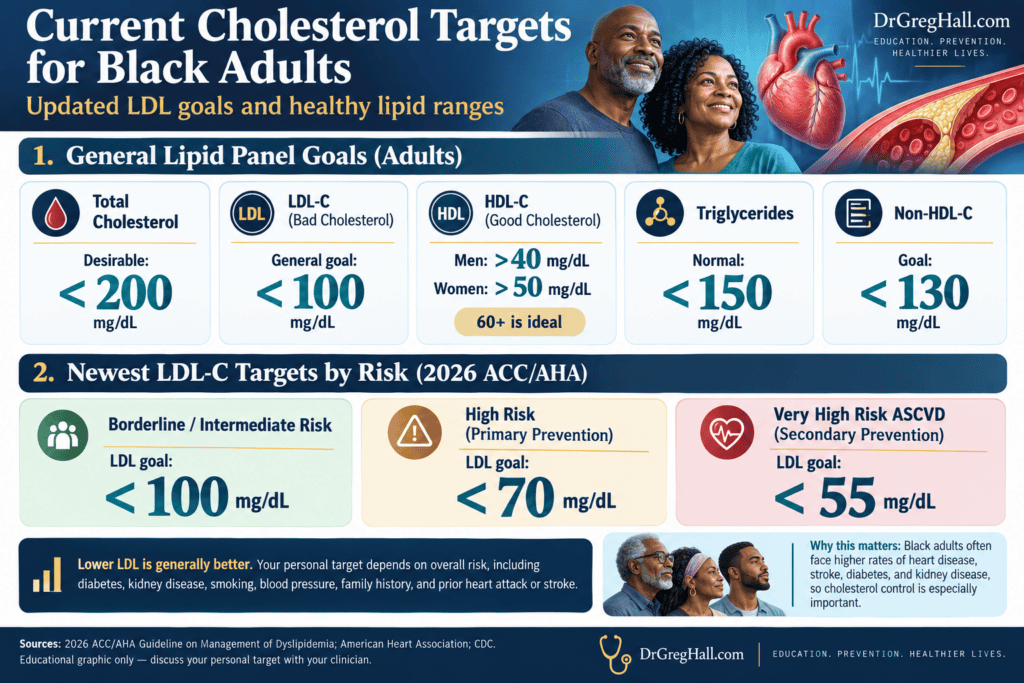
What should my cholesterol levels be?
Your LDL, or “bad” cholesterol, goal depends on your overall risk. The 2026 ACC/AHA cholesterol guideline sets these targets:
- Lower risk, no heart disease: LDL under 100
- Higher risk (10-year risk of 10% or more), no heart disease yet: LDL under 70
- Already had a heart attack, stroke, or blocked arteries: LDL under 70, and under 55 for those at very high risk
Large studies of numerous patients have shown substantial benefit of cholesterol lowering medicines with significantly decreased heart attacks, strokes, and other circulation related medical problems.
Do statins help people with kidney problems?
Yes, by protecting the heart and blood vessels. In the SHARP trial of more than 9,000 people with chronic kidney disease, lowering LDL cut major heart attacks, strokes, and artery-opening procedures by about 17%. It did not slow the kidney disease itself, so blood pressure and blood sugar control remain the keys to protecting the kidneys. Kidney disease is very common in the Black community, and people with kidney disease face a high risk of heart attack and stroke, so that protection matters.
African Americans have “better” cholesterol. So why more heart disease?
On average, African Americans have higher HDL (“good”) cholesterol and lower triglycerides than White Americans, and the difference is not explained by diet or exercise. Yet African Americans have higher rates of heart disease and stroke. Researchers have puzzled over this for years:
“It is clear that there is further complexity in this relationship among African Americans, who have, on average, a more favorable lipid profile compared to European Americans, yet they do not experience an associated decrease in diseases that are expected to be responsive to reduction in this key risk factor”
NIH Publication
Part of the answer is that uncontrolled high blood pressure, obesity, and diabetes can overwhelm the benefit of better numbers. Precision medicine explains the rest.
The precision medicine connection
Precision medicine looks past population averages to your own biology. For cholesterol, it shows why a “good” lipid panel can give Black patients false reassurance.
1. “Good” cholesterol may not protect Black adults the same way
In the REGARDS study of nearly 24,000 adults followed for about 10 years, low HDL predicted heart attacks in White adults but not in Black adults, and high HDL protected neither group (Journal of the American College of Cardiology, 2022). A high HDL number is not a reason to skip a statin.
2. The cholesterol a standard panel misses: lipoprotein(a)
Lipoprotein(a), or Lp(a), is an inherited, LDL-like particle that raises the risk of heart attack and stroke. People of African ancestry have, on average, the highest Lp(a) levels of any group, but a routine lipid panel does not measure it. The 2026 ACC/AHA guideline now recommends that every adult have Lp(a) checked at least once; a level of 50 mg/dL or higher signals added risk. If you have never had it checked, ask.
3. A gene found in African Americans led to a new class of medicines
In 2006, researchers studying Black participants in the ARIC study found that about 2.6% carried a natural variant in the PCSK9 gene. Those carriers had 28% lower LDL and an 88% lower risk of coronary heart disease over 15 years (New England Journal of Medicine). That discovery led directly to PCSK9 inhibitor medicines, used today when LDL stays too high on a statin. It is also powerful proof that lower LDL, over a lifetime, protects African Americans.
4. Muscle aches: know your baseline
Black adults naturally tend to have higher levels of creatine kinase (CK), the muscle enzyme doctors check when a statin causes aches. A CK that looks “high” may be normal for you. Muscle symptoms should be sorted out with your doctor, often by adjusting the dose or switching statins, rather than by stopping the medicine on your own.
These are the kinds of differences covered in Better Black Health, written for patients and families, and Precision Medicine for African Americans (Springer Nature), written for clinicians.
Less Prescribed & Less Taken

Unfortunately, African Americans have a poor track record of taking cholesterol lowering medicines when prescribed after a stroke, heart attack, or most other reasons for starting the medication. And doctors are less likely to prescribe statins in African Americans across the board. The result is a deadly combination of a doctor that is less likely to give a medication to a patient . . . and a patient that is less likely to take it. This inconsistency speaks to the trust issues African Americans have with doctors.
Overall statin use and lowering cholesterol saves lives. Dr. Carol Watson, a Black cardiologist said it best in her article “Let the evidence speak”
“These trials thus confirm that significant benefits can occur from statin use in African Americans. Despite this, however, statins remain underutilized in the African American population, thus those that might stand to benefit most, are least likely to receive these life saving medications.”
So, are statins bad for you?
The answer for African Americans is crystal clear: lowering LDL cholesterol leads to fewer heart attacks, fewer strokes, better circulation, fewer amputations, and longer lives. Don’t get it twisted. And bring two precision questions to your next visit: “What is my Lp(a)?” and “What should my LDL goal be?”